Decorative door pulls combine style and function, serving as a key design element for your home. Here’s what you need to know to choose the right one:
- Match Your Door Type: Exterior doors need durable materials like stainless steel or brass, while interior doors allow for more flexibility. Sliding and glass doors may require specific mounting systems.
- Get the Measurements Right: Measure door thickness and existing screw hole spacing (center-to-center distance) for a secure and precise fit.
- Pick a Style: Bar pulls offer modern appeal, cup pulls suit vintage looks, and appliance pulls work for heavy-duty doors. Consider back-to-back pulls for dual-sided use on glass or sliding doors.
- Choose Materials: Stainless steel resists corrosion, brass adds a premium feel, and bronze ages beautifully with a patina.
- Select Finishes: Matte black is modern and low-maintenance, while antique brass or bronze adds character. Satin finishes hide wear better than polished ones.
- Plan for Installation: Ensure compatibility with your door’s thickness and setup. Use tools like painter’s tape and laser levels for proper alignment.
For homeowners in coastal regions like South Carolina, prioritize weather-resistant materials like Grade 316 stainless steel to handle humidity and salt air. Need help? Local providers like Icon Window & Door offer tailored options for durable, stylish hardware.
Decorative pulls are more than hardware – they’re a design statement. Choose wisely to balance style, durability, and practicality.
Assess Your Door Type and Size
Before picking the perfect pull design, it’s important to know what type of door you’re working with. Each door type has specific needs that influence which pulls will work best. Let’s break it down.
Exterior doors that face weather conditions need tough materials like stainless steel, brass, or bronze. These doors also require additional security hardware, such as deadbolts, to keep them secure.
Interior doors offer more flexibility based on their purpose. For instance:
- Bedrooms and bathrooms often need privacy pulls with locking mechanisms.
- Hallways and closets are better suited to passage pulls.
- Dummy pulls work well for decorative purposes on inactive double doors.
Sliding and pocket doors call for flush or recessed pulls that sit within the door’s surface. This prevents the pull from snagging during operation.
Glass and steel doors often require back-to-back mounting, where handles on both sides are connected through the door. For frameless glass doors, patch fittings or clamp-on pulls are ideal to avoid putting stress on the glass.
Understanding these differences ensures your pull design isn’t just stylish but also practical.
Don’t Skip the Measurements
Getting the dimensions right is just as important as choosing the design. Start with the door’s thickness – your pull’s mounting bolts must fit properly to ensure secure installation. Also, measure the center-to-center (C-C) distance of existing screw holes to avoid unnecessary re-drilling. As Ironmongery World points out:
"Ensure that the handle you choose fits the door’s thickness; you don’t want a handle that’s too long or too short."
Before drilling, use painter’s tape to map out the pull’s placement. For ladder pulls, a laser level is a great tool to ensure everything stays perfectly aligned. Taking these steps guarantees a flawless fit and finish.
sbb-itb-cdbcc3e
Select the Right Pull Styles and Shapes
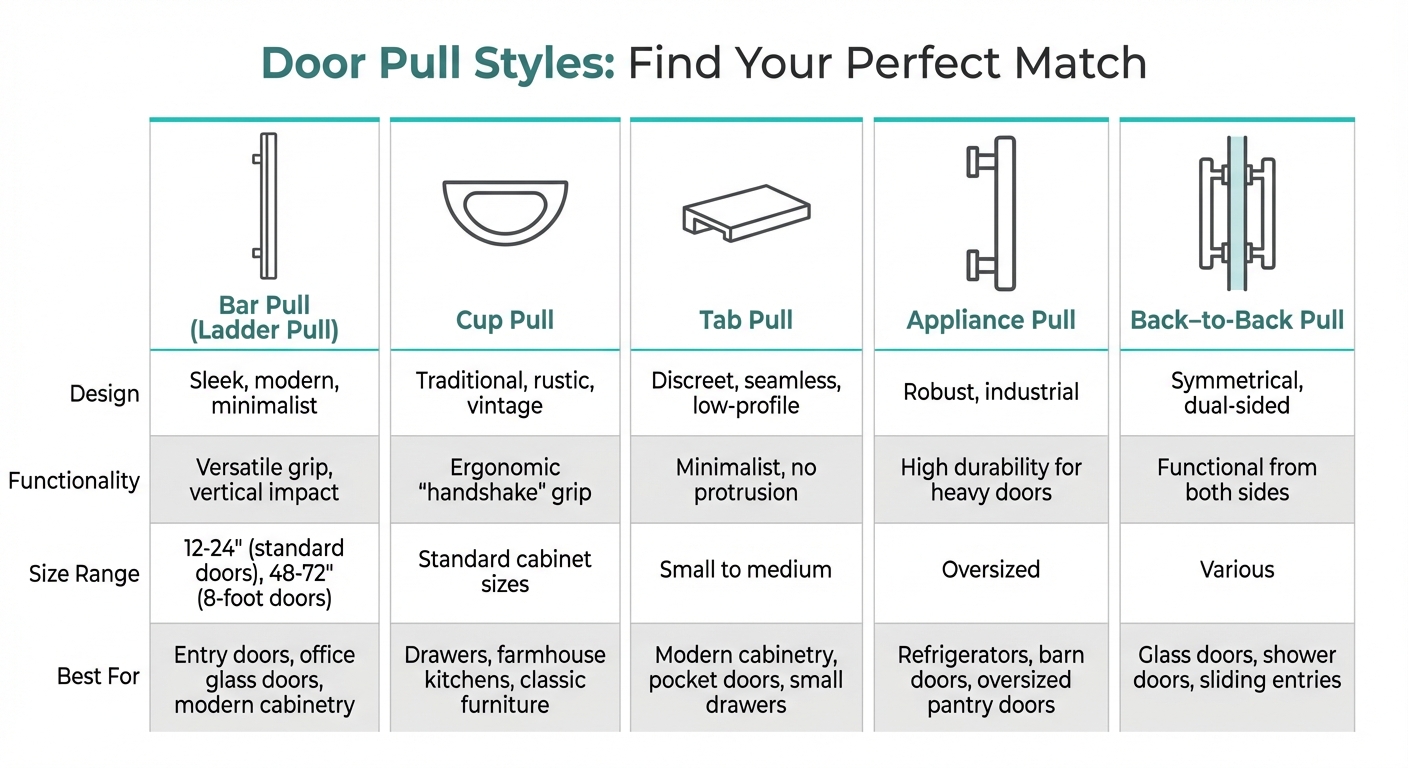
Door Pull Styles Comparison Guide: Types, Design and Best Uses
Once you’ve identified your door type, the next step is selecting a pull style that enhances your home’s overall look. This decision goes beyond function – it’s about adding a design element that complements your space. As CANGO aptly states:
"A door pull handle isn’t merely functional; it’s a piece of sculpture that greets the world."
The pull shape you choose should strike a balance between practicality and design. Below is a breakdown of some of the most popular pull styles and their key features.
Bar Pulls
Bar pulls, often referred to as ladder pulls, feature sleek, elongated lines that bring a bold vertical accent to your door. Their straightforward design makes them a versatile choice for various settings, from modern office glass doors to sturdy wooden entryways. Standard doors typically use pulls measuring 12 to 24 inches, while taller doors – like 8-foot entries – can accommodate pulls ranging from 48 to 72 inches. For precise installation, use a laser level to ensure perfect vertical alignment.
Cup and Tab Pulls
Cup pulls, with their semi-circular shape, offer a natural grip and fit well with traditional or farmhouse aesthetics. They’re a great match for antique furniture or farmhouse-inspired kitchens. On the other hand, tab pulls provide a sleek, low-profile option, mounting discreetly to the door edge for a seamless look .
Appliance Pulls
Built for durability, appliance pulls are designed to handle the weight of heavy doors like those on integrated refrigerators, oversized pantry doors, or barn doors. These oversized handles not only provide a secure grip but also add a bold, industrial touch to the door’s overall appearance.
Back-to-Back Pull Handles
Back-to-back pull handles are installed on both sides of a door, connected by a central bolt. This design is ideal for glass or sliding doors, offering access from either side while maintaining a balanced and cohesive look. They’re especially popular for shower doors, office partitions, and modern sliding doors.
| Pull Type | Design Aesthetic | Best Functionality | Common Applications |
|---|---|---|---|
| Bar Pull | Sleek, modern, minimalist | Versatile grip, vertical impact | Entry doors, office glass doors, modern cabinetry |
| Cup Pull | Traditional, rustic, vintage | Ergonomic "handshake" grip | Drawers, farmhouse kitchens, classic furniture |
| Tab Pull | Discreet, seamless, low-profile | Minimalist, no protrusion | Modern cabinetry, pocket doors, small drawers |
| Appliance Pull | Robust, industrial | High durability | Oversized doors, refrigerators, barn doors |
| Back-to-Back | Symmetrical, dual-sided | Functional from both sides | Glass doors, shower doors, sliding entries |
Once you’ve chosen a style, focus on selecting the right size and proportions to ensure the pull not only looks great but also functions perfectly.
Determine Proper Sizing and Proportions
Getting the size right for door pulls isn’t just about looks – it’s about functionality too. A pull that’s too small on a tall door can feel flimsy, while one that’s too large on a small door can look out of place. Striking the right balance is key.
Start by understanding the center-to-center measurement (the distance between screw holes) and the overall length (the full end-to-end measurement). Typically, the overall length is about 2 inches longer than the center-to-center distance. Another important dimension is projection, which measures how far the pull extends from the door surface. This ensures enough clearance and a comfortable grip.
Here’s a quick guide to sizing:
- Standard cabinet doors (24–34 inches tall): Pulls between 6 and 8 inches work well.
- Tall doors (42 inches or taller): Opt for pulls that are 10 inches or longer to keep proportions balanced.
- Pantry doors (around 80 inches tall): Pulls between 12 and 17 inches help frame the door visually.
As DoorCorner explains:
"Unlike drawer fronts – where the ‘one-third rule’ often applies – door sizing is more flexible. Use scale and balance for your space".
Before making any permanent decisions, mark the pull’s length on the door using painter’s tape. This simple step lets you see how the pull will look and feel in its actual position, helping you avoid costly mistakes. Don’t forget to test ergonomics too – Built Cabinets suggests a center-to-center length of at least 3¾ inches for comfortable use.
When it comes to placement, keep it simple: on modern slab doors, position the hardware about 2 inches from the side and bottom edges. For paneled doors, align the bottom of the pull with the lower rail for a polished look.
Taking the time to measure and plan ensures a smooth installation process and hardware that not only looks great but works perfectly. Once the sizing is sorted, the next step is choosing materials and finishes that fit your overall design.
Choose Materials and Finishes
After finalizing the dimensions, the next step is selecting materials and finishes that balance durability and style. The material of your door pulls plays a key role in both their look and how well they hold up over time. As Cassandra Peterson from Ageless Iron Hardware explains:
"The material you choose impacts more than just aesthetics – it determines longevity, strength, and overall performance".
Materials to Consider
Stainless steel is a top choice for its resistance to wear and corrosion. If you’re in a coastal area, go for Grade 316 stainless steel, which is specifically designed to handle salty air .
Solid brass is another excellent option, offering a premium feel and natural antimicrobial properties. Its weight and resistance to corrosion make it ideal for damp areas like bathrooms or exterior doors. High-quality brass and stainless steel door pulls typically start at around $95.
Solid bronze stands out for its durability and timeless appeal. Over time, it develops a patina that adds character, making it a favorite for those seeking an old-world aesthetic. Bronze sets generally start at about $140.
Choosing the Right Finish
The finish you select should complement your space while being practical for everyday use. Here are some popular options:
- Matte black: A modern favorite, it hides fingerprints and is often treated with PVD coating for scratch resistance .
- Antique brass: Sometimes referred to as antique gold, this finish adds a vintage charm, perfect for traditional homes .
- Polished finishes: These high-gloss, mirror-like surfaces exude luxury but require regular cleaning to manage smudges .
- Satin or brushed finishes: Offering a soft, understated glow, these finishes are great for hiding minor imperfections and need minimal upkeep .
Matching Style and Functionality
When choosing finishes, think about both aesthetics and maintenance. For modern spaces, sleek options like matte black or stainless steel work beautifully. Traditional designs pair well with warm tones like antique brass or aged bronze, while rustic or farmhouse styles shine with oil-rubbed bronze . In high-traffic areas, finishes like satin chrome, satin nickel, or stainless steel are practical since they handle wear and tear better .
For coastal homes, prioritize Grade 316 stainless steel or PVD "lifetime finishes" to resist salt-air corrosion . Keep in mind that some finishes require more care than others. For example, unlacquered brass needs regular polishing to maintain its shine, while lacquered brass is easier to clean. Living finishes, like antique bronze, develop a patina over time and should be cleaned gently to avoid damage. As San Diego Hardware notes:
"A living finish means the color can be expected to change and age over time… these finishes can give your hardware added character and make your home look more historic".
Check Functionality and Installation Compatibility
Before installing a door pull, make sure it aligns with your door’s specifications. Most residential doors follow standard thicknesses: 1 3/8 inches for interior doors and 1 3/4 inches for exterior doors. However, custom-built or vintage doors might not fit these norms. In such cases, you may need adjustable or specially designed pulls. As Cortney Gillett, Sales Director at Rocky Mountain Hardware, explains:
"The thickness of your door plays a crucial role in determining compatibility… custom or antique doors may deviate from these standards, requiring an adjustable or specially fitted door knob."
Start by measuring key dimensions: the door thickness, the backset (commonly 2 3/8 inches or 2 3/4 inches in North America), and the borehole diameter (usually 2 1/8 inches). Also, double-check that the mounting screws or bolts included with your pull match your door’s thickness. If they’re too short or too long, the pull won’t install securely.
Material choice also plays a big role in compatibility. For example:
- Solid wood doors: Reinforced pulls are essential to handle the weight.
- Glass doors: Require specialized back-to-back mounting systems to avoid cracking.
- Heavier doors: Might need pulls and hinges rated for higher weight. In some cases, you’ll need four hinges instead of the usual three.
For exterior doors, prioritize weather-resistant materials like stainless steel, brass, or bronze. Pair these with a deadbolt and either a roller or magnetic catch for added security. If you live in a coastal area, opt for Grade 316 stainless steel to prevent corrosion caused by salt air.
Lastly, if you’re using a split-finish design, ensure the mechanical structure is consistent and that both sides match in size. For long ladder pulls (48–72 inches), a laser level is a must for precise alignment.
Explore Icon Window & Door Hardware Options
Continuing with your hardware selection journey, Icon Window & Door has introduced a solution tailored specifically for the unique needs of South Carolina’s Lowcountry. Whether you’re in Charleston, Beaufort, or Kiawah Island, their new hardware line is designed to address the challenges posed by the region’s climate. While premium handles, locks, and hinges are still listed as "Coming Soon", homeowners and contractors can already book a free consultation to explore custom solutions.
This upcoming hardware collection is crafted to complement doors made from wood, fiberglass, steel, and clad finishes, blending seamlessly with both the classic charm and modern aesthetics of the Lowcountry. Available finishes include bronze, black, and chrome – each engineered to endure the area’s heat, humidity, and salty air. As the Icon team puts it:
"We offer a carefully curated selection of premium locks, handles, and hinges for interior and exterior doors. Whether you’re drawn to timeless bronze, bold black, or polished chrome, our hardware options are built to last and designed to complement any aesthetic."
What sets Icon Window & Door apart is their commitment to personalized service. With over 50 years of combined experience, their team provides expert advice to help you choose hardware that balances style, durability, and security. Customization options are also available, allowing you to select sizes, finishes, and configurations that suit your specific needs. For coastal properties, corrosion-resistant, weatherproof options are available to ensure long-lasting performance, even in the harshest conditions.
To get started, visit iconwindowanddoor.com or schedule a site visit for precise measurements and fittings. As a family-run business based in South Carolina, Icon Window & Door has a deep understanding of local architectural styles and environmental factors. With these tailored options, you’re well on your way to completing the perfect door hardware selection.
Conclusion
Selecting decorative door pulls involves balancing aesthetics, practicality, and durability. Start by considering your door type and its environment. For exterior doors, prioritize corrosion-resistant materials to withstand weather conditions, while interior doors allow for greater design flexibility. Choose styles and finishes that align with your home’s overall look – sleek matte black works well in modern spaces, while warm brass adds charm to more classic designs. Be mindful of proportions, ensuring the pull size complements the door’s dimensions for a cohesive appearance.
A door pull is more than just a functional detail; it’s the first physical interaction guests have with your home. This small feature sets the tone for your space while adding to its overall design and usability.
Once you’ve chosen a style and size, check for installation compatibility. Ensure the pull matches your door’s thickness and hardware setup. Since pull handles are stationary, remember to include additional mechanisms like deadbolts or magnetic catches for proper security or functionality.
For homeowners in South Carolina’s Lowcountry, these considerations are even more critical. At Icon Window & Door, we’re here to guide you through selecting materials, coordinating finishes, and addressing installation needs. Our soon-to-launch hardware collection is designed to endure the region’s heat, humidity, and salt air while enhancing your home’s aesthetic.
Interested in finding the perfect decorative door pulls for your home? Schedule a free consultation at iconwindowanddoor.com to explore options crafted for performance and style in South Carolina’s unique climate.
FAQs
Do I need back-to-back pulls on my door?
When deciding on door handles, you don’t always need back-to-back pulls unless you’re aiming for a particular design or added practicality. For most doors, a single pull handle does the job, giving off a sleek and straightforward vibe. That said, if your door is larger or heavier, back-to-back pulls can provide balance and make the door easier to operate. Ultimately, the decision comes down to your door’s dimensions, style, and how you plan to use it.
How do I know if a pull will fit my door thickness?
To make sure a door pull fits your door’s thickness, start by examining the handle’s design and the compatibility of its mounting hardware with your door type. Check that the screws and other hardware are the correct length for the thickness of your door. Handles with adjustable mounting hardware or multiple screw lengths can be a good option for doors of varying sizes. Always select a pull specifically designed for your door type to ensure a secure and proper fit.
What’s the best pull material for a coastal home?
Marine-grade 316 stainless steel stands out as the top choice for coastal homes. Why? It resists rust, handles wear and tear exceptionally well, and needs very little upkeep. Its corrosion-resistant nature makes it perfect for enduring the salty, harsh air typical of coastal areas.