If you’re upgrading your windows, selecting the right materials is key to ensuring durability, energy efficiency, and long-term savings – especially in challenging climates like South Carolina’s coastal region. Here’s what you need to consider:
- Climate Matters: High humidity, salt air, intense sunlight, and hurricane winds can damage poorly chosen materials. Opt for frames that resist rot, warping, and corrosion.
- Material Lifespan: Fiberglass and composite frames last 40–55 years with minimal upkeep, while wood frames require regular maintenance and vinyl can soften under intense heat.
- Energy Efficiency: Look for windows with low U-factors (≤0.30), low Solar Heat Gain Coefficients (≤0.23), and advanced features like Low-E coatings, gas fills, and warm-edge spacers.
- Maintenance Needs: Materials like vinyl, fiberglass, and composites are low-maintenance. Wood, while aesthetically pleasing, needs resealing every 2–5 years.
- Professional Installation: Proper installation ensures airtight seals and protects warranties. Custom sizing enhances performance and longevity.
Quick Comparison of Frame Materials
| Frame Material | Price Range | Lifespan | Maintenance | Best Use in SC |
|---|---|---|---|---|
| Wood | $150–$1,300 | 20+ years | High (reseal often) | Historic homes |
| Vinyl | $100–$900 | 30–40 years | Minimal | Inland, budget-friendly |
| Aluminum | $75–$400 | 30–50+ years | Low | Large windows |
| Fiberglass | $500–$1,500 | 45–55 years | Minimal | Coastal, long-term use |
| Composite | $300–$1,200 | 40–50+ years | Low | Wood look, low upkeep |
Pro Tip: Don’t just upgrade the glass – frames matter too. Durable materials and expert installation can save you $126–$465 annually on energy bills.
Window Frame Materials Comparison: Cost, Lifespan, and Maintenance Guide
Know Your Climate and Weather Conditions
South Carolina’s humid subtropical climate brings unique challenges for window durability. Summers often see temperatures in the 90s°F, paired with high humidity that can lead to issues like condensation, mold growth, and even structural damage. Constant exposure to moisture means wood frames can absorb water, leading to rot, warping, and sticking – a recipe for rapid deterioration.
Check Weather Resistance Needs
Coastal areas like Charleston and Beaufort contend with extra challenges, including salt spray, which speeds up hardware corrosion and damages frames not built for coastal environments. On top of that, intense UV exposure can weaken materials and increase cooling demands, while hurricane-force winds require windows to meet strict standards. For example, coastal building codes mandate windows capable of withstanding wind speeds between 130 and 150 mph. To meet these demands, impact-resistant windows are rigorously tested – this includes firing a 9-pound piece of lumber at them at 50 feet per second.
"Humidity and salt air are tough on homes. Wood can swell and rot, metal can corrode, and seals can break down faster than usual." – Wallaby Windows
Plan for Long-Term Energy Performance
Your choice of materials plays a major role in energy efficiency over the years. Energy Star-rated windows for the Southern Climate Zone can cut cooling costs by up to 25% during peak summer heat. However, this efficiency only holds if the materials used can retain their insulation properties over time. For instance, aluminum frames aren’t ideal for South Carolina’s climate because they conduct heat too easily. On the other hand, vinyl and fiberglass frames with insulated cores offer better thermal performance.
In South Carolina’s coastal areas, windows typically last 15 to 25 years, but salt exposure can shorten this lifespan. Materials prone to warping, seal failure, or corrosion often lead to early replacements and higher costs. Understanding how materials perform in this specific climate is essential as you evaluate your options for window frames.
sbb-itb-cdbcc3e
Compare Window Frame Materials
When planning a window replacement for South Carolina’s unique climate, it’s crucial to weigh each material’s performance, cost, and upkeep. Here’s a breakdown of the most common options:
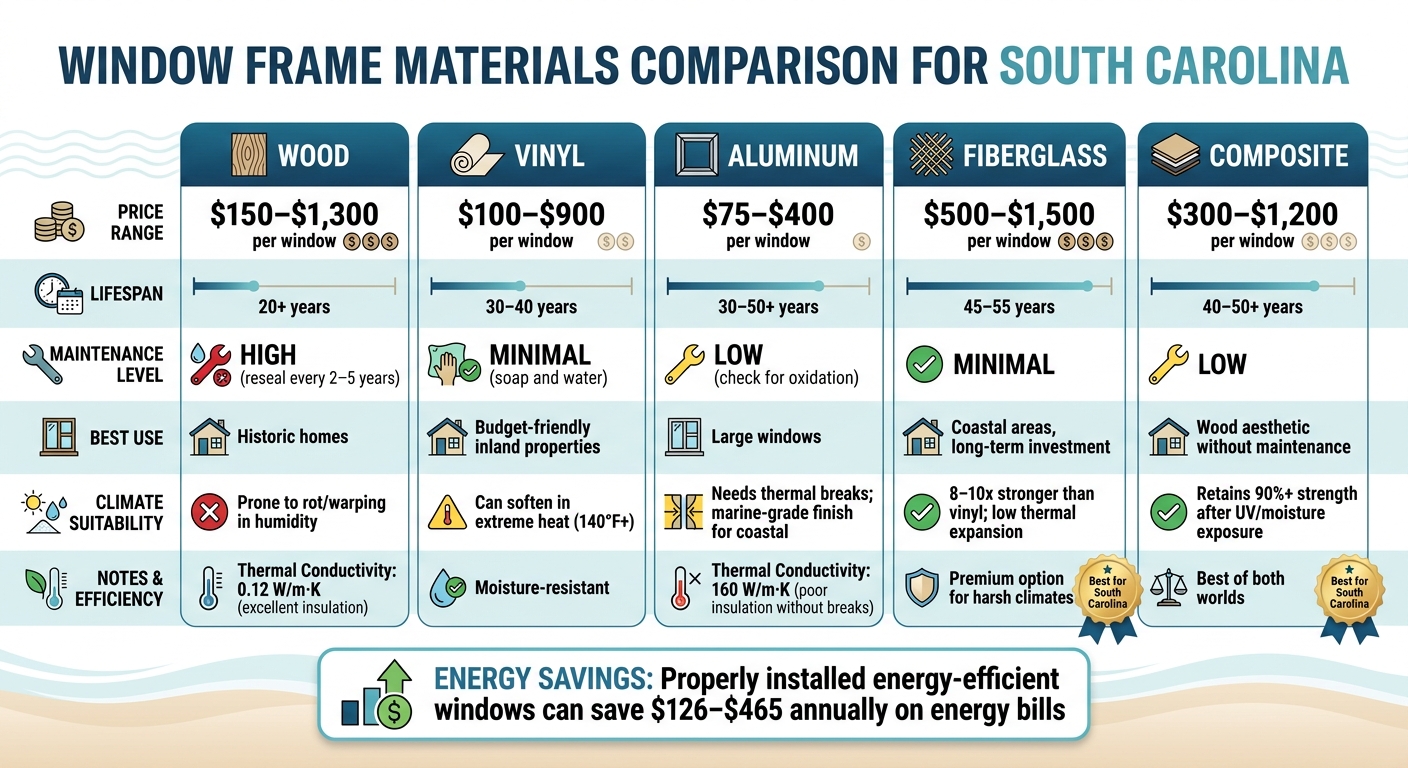
Wood frames are known for their natural insulating properties (0.12 W/m·K), offering a classic aesthetic that can last over 20 years. However, South Carolina’s high humidity makes regular maintenance a must, as wood is prone to swelling, warping, and rot. Expect to repaint or reseal every 2–5 years. Costs range from $150 to $1,300 per window.
Vinyl frames are a cost-effective choice, priced between $100 and $900 per window. These frames resist moisture and require little upkeep, making them a practical option for many homeowners. They typically last 30–40 years. However, dark-colored vinyl frames may soften or warp under South Carolina’s intense sun, where surface temperatures can exceed 140°F. Additionally, vinyl may lack the structural strength needed for large window spans.
Aluminum frames are ideal for large windows, thanks to their strength and durability. They last 30–50+ years and cost between $75 and $400 per window. While they require minimal maintenance, aluminum conducts heat quickly (thermal conductivity of around 160 W/m·K), which can reduce energy efficiency unless thermal breaks are included. In coastal areas, marine-grade finishes are essential to prevent corrosion from salt spray.
Fiberglass frames are a high-end option, priced at $500 to $1,500 per window. These frames are 8–10 times stronger than vinyl and have a low thermal expansion rate, helping to prevent seal failure during temperature changes. With a lifespan of 45–55 years and minimal maintenance, fiberglass is well-suited for South Carolina’s hot, humid, and coastal environments.
For those wanting a mix of style and resilience, composite frames are a solid choice. They combine the look of wood with the durability of modern polymers, costing between $300 and $1,200 per window. Composite frames can retain over 90% of their strength after decades of UV and moisture exposure, making them a long-lasting, low-maintenance option.
| Frame Material | Price Range | Lifespan | Maintenance | Best SC Application |
|---|---|---|---|---|
| Wood | $150–$1,300 | 20+ years | High (seal every 2–5 years) | Historic homes (with regular upkeep) |
| Vinyl | $100–$900 | 30–40 years | Minimal | Budget-conscious inland properties |
| Aluminum | $75–$400 | 30–50+ years | Low | Large windows (with thermal breaks) |
| Fiberglass | $500–$1,500 | 45–55 years | Minimal | Coastal areas, long-term investment |
| Composite | $300–$1,200 | 40–50+ years | Low | Wood aesthetic without maintenance |
This table provides a quick comparison to help you choose the best material for your home’s specific needs and location.
Check Energy Efficiency Ratings
Once you’ve chosen durable materials, the next step is to focus on energy performance. To compare windows effectively, rely on the National Fenestration Rating Council (NFRC) label. This label provides key details about how a window handles heat loss, solar gain, and air leakage.
Key Energy Ratings to Watch
- U-factor: This measures how quickly heat escapes through the window. A lower U-factor means better insulation. For South Carolina’s mixed climate, aim for a U-factor of 0.30 or lower to keep your home comfortable.
- Solar Heat Gain Coefficient (SHGC): This tells you how much solar radiation passes through the glass. Given South Carolina’s hot summers, look for an SHGC lower than 0.23 to cut cooling costs. This rating can help reduce your monthly utility bills by as much as 15%.
Advanced Features for Better Efficiency
To further boost performance, consider windows with advanced features:
- Low-E Coatings: These ultra-thin metallic layers can reduce energy loss by 30% to 50%, even though they cost 10% to 15% more. Spectrally selective Low-E coatings are especially useful in hot climates, blocking 40% to 70% of heat while still letting in natural light.
"Windows manufactured with low-e coatings typically cost about 10% to 15% more than regular windows, but they reduce energy loss by as much as 30% to 50%." – U.S. Department of Energy
- Gas Fills: Between glass panes, argon gas minimizes heat transfer in standard ½-inch gaps, while krypton gas works better in thinner ¼-inch gaps. These gas fills lose less than 1% per year, ensuring long-term efficiency.
- Warm-Edge Spacers: These keep glass panes apart and help reduce condensation along the edges, improving durability and performance.
Air Leakage and Window Design
For the best performance, choose window styles that naturally limit air leakage. Casement or awning windows, for example, seal more tightly than sliding or double-hung designs. Look for air leakage rates of 0.30 cfm/ft² or less to maintain efficiency over time.
If you’re in South Carolina and want expert guidance, the team at Icon Window & Door can help you navigate these ratings. By understanding these energy efficiency metrics, you can select windows that offer long-term comfort and savings.
Review Maintenance and Warranty Terms
Understand Maintenance Requirements
The care your windows require plays a big role in their lifespan and overall cost over time. For example, wood frames need repainting or resealing every 3–5 years to guard against rot and insect damage. When given proper attention, wood windows can last anywhere from 30 to 50 years.
On the other hand, materials like vinyl, fiberglass, and composite frames are much easier to maintain – usually just needing occasional cleaning with soap and water. Vinyl frames typically last 20–40 years, fiberglass can exceed 50 years, and composite options like Fibrex hold up for 40–50 years while resisting issues like fading, flaking, and peeling. Aluminum frames are another durable option, as they won’t rot or warp, but they should be checked periodically for surface oxidation, especially if you live near the coast.
"Choosing low-maintenance materials reduces long-term effort and costs while ensuring windows last longer." – Vistaza
Here’s a real-world example: In October 2025, a North Carolina homeowner switched from wood windows to vinyl frames. This change cut their maintenance costs by 30% over five years.
Once you fully understand the maintenance needs, turn your attention to warranty details to protect your investment.
Examine Warranty Coverage
A reliable warranty is essential for peace of mind. Ideally, you should have two types of warranties: one from the manufacturer covering potential issues like glass seal failures, frame warping, or hardware problems, and another from your contractor that guarantees the quality of the installation work. For instance, Fibrex windows come with a 20-year warranty for the glass and a 10-year warranty for other parts.
Be sure to read the fine print, especially exclusions and limitations. For example, painting vinyl frames after installation or failing to reseal wood frames every few years could void your warranty. If you’re using wood windows, keep a maintenance log. Also, check if the warranty can be transferred to future homeowners – it’s a great selling point if you decide to put your house on the market.
Before finalizing your choice, consider getting a professional consultation. In March 2023, a Charleston homeowner met with a local window expert, which led to selecting fiberglass windows. These windows boosted energy efficiency by 30% and came with a 25-year warranty covering both materials and installation. A professional assessment ensures you pick windows that match your region’s climate and maintenance needs while securing solid warranty protection for your investment.
Get Professional Installation and Custom Sizing
Even the best windows won’t perform as they should if they’re not installed correctly. Professional installation is key to ensuring your windows achieve their rated U-factor and Solar Heat Gain Coefficient (SHGC) potential. As the Department of Energy notes, "Even the most energy-efficient window must be properly installed to ensure energy efficiency and comfort". Improper installation can lead to air and water leaks, weakening the seals and reducing the window’s durability over time.
Professional installers go beyond just placing the window in the frame. They inspect the rough opening for signs of water damage, rot, or structural problems before starting the installation process. Techniques like applying weather-resistant barriers, flashing, and low-expansion foam insulation help prevent leaks. Installers also use shims to align windows properly, ensuring that casement or double-hung models seal tightly and operate smoothly.
Custom sizing takes window performance to the next level. Unlike standard sizes, custom-fit windows are tailored to each frame, accommodating different thermal expansion rates. For example, vinyl expands at a rate of 3.42, while fiberglass expands more closely to glass, preserving the integrity of the seals. Fusion-welded corners also add to airtightness, outperforming mechanically fastened corners.
Opting for a full-frame replacement, which costs between $700 and $1,000 per window, allows for a thorough inspection of the frame. This approach also improves flashing and waterproofing compared to insert installations. Additionally, many manufacturers require professional installation to honor their warranties. When done right, energy-efficient windows combined with professional installation can save you between $126 and $465 annually on energy bills, depending on your home’s location and the condition of your current windows.
The type of hardware used also plays a big role in your window’s durability. For example, compression seals on casement or awning windows provide better air-tightness than sliding styles. Plus, corrosion-resistant hardware ensures smooth operation throughout the window’s lifespan, which can range from 20 to 40 years. If you’re in South Carolina, working with experienced local professionals – like the team at Icon Window & Door – can help ensure your windows are sized, sealed, and equipped with the right hardware for long-lasting performance.
Your Window Material Selection Checklist
When choosing the right window materials, it’s essential to weigh a few key factors to ensure your windows are durable and perform well over time. Start by considering your local climate. For areas with extreme temperature changes, fiberglass and composite frames are excellent options because they resist thermal expansion. If you live in a humid or coastal region, vinyl and fiberglass materials are better suited for handling moisture without warping or deterioration. Don’t forget to check the NFRC ratings to confirm energy efficiency.
Next, think about how much maintenance you’re willing to commit to. If you’d rather avoid frequent upkeep, vinyl, fiberglass, or composite windows are ideal since they only need occasional cleaning with soap and water. On the other hand, wood frames provide great insulation and a timeless aesthetic, but they require resealing or repainting every 3–5 years to prevent issues like rot. If you love the look of wood but not the maintenance, clad-wood windows offer a great compromise.
Energy efficiency is another critical factor. Look for windows with low-e coatings and warm-edge spacers to reduce heat loss and improve insulation. Additionally, certain styles like casement and awning windows tend to seal more tightly compared to sliding models, making them a more energy-efficient choice.
Finally, make sure your windows are installed by certified professionals. Proper installation not only ensures optimal performance but also protects your warranty, as many manufacturers require certified installation to honor their terms. If you’re in South Carolina, reaching out to experts like Icon Window & Door can help you get tailored advice that fits your architectural style, local building codes, and climate needs.
FAQs
Which window frame material is best for coastal South Carolina?
Fiberglass window frames are a great choice for coastal South Carolina. They stand up well against warping, rotting, and swelling, even when faced with the area’s humid and rainy weather. This durability makes them a dependable option for the region’s tough climate.
What NFRC ratings should I prioritize for hot, humid climates?
For hot and humid climates, prioritize windows with NFRC ratings that feature a low Solar Heat Gain Coefficient (SHGC) – ideally 0.40 or lower. This reduces the amount of solar heat entering your home, helping to keep it cooler and more energy-efficient.
Do I need full-frame replacement or insert windows?
When deciding between full-frame replacement and insert windows, the right choice depends on your specific needs.
- Full-frame replacement involves removing the entire window, including the frame. This option works best if the frame is damaged or if you’re planning to change the window’s style or size.
- Insert windows, on the other hand, fit into the existing frame. They’re faster to install and less disruptive, making them a great option if the current frame is still in good shape.
To make the best decision, consider factors like energy efficiency, the condition of the structure, and the overall look you want. A professional can provide guidance tailored to your home.