Choosing between interior and exterior doors for your Charleston home boils down to their purpose, materials, and installation needs. Exterior doors are built for security, weather resistance, and energy efficiency, while interior doors focus on privacy, sound control, and aesthetics. Charleston’s humid, coastal climate adds unique challenges for exterior doors, requiring durable materials like fiberglass or steel and proper sealing to withstand heat, humidity, and storms. Interior doors, being shielded from the elements, use lighter materials like hollow-core wood or MDF.
Key differences:
- Exterior Doors: Prioritize security, energy savings, and durability; built with solid cores, weatherproof seals, and impact-resistant features.
- Interior Doors: Focus on style, noise reduction, and lightweight design; often made from hollow-core materials for affordability.
Quick Comparison:
| Feature | Exterior Doors | Interior Doors |
|---|---|---|
| Purpose | Security, weather resistance, energy efficiency | Privacy, sound control, aesthetics |
| Materials | Fiberglass, steel, hardwood | MDF, hollow-core wood, composites |
| Installation | Requires weatherproofing, permits in some cases | Simpler, no permits needed |
| Cost Range | $550–$2,000 | $375–$1,125 |
| Energy Efficiency | High, reduces energy loss by 15%–25% | Not a focus |
Exterior doors are essential for protection and energy savings, while interior doors enhance functionality and style within your home. For Charleston’s climate, fiberglass exterior doors are a durable, cost-effective choice, while interior doors offer flexibility in design and budget. Proper installation and maintenance ensure long-term performance and value.
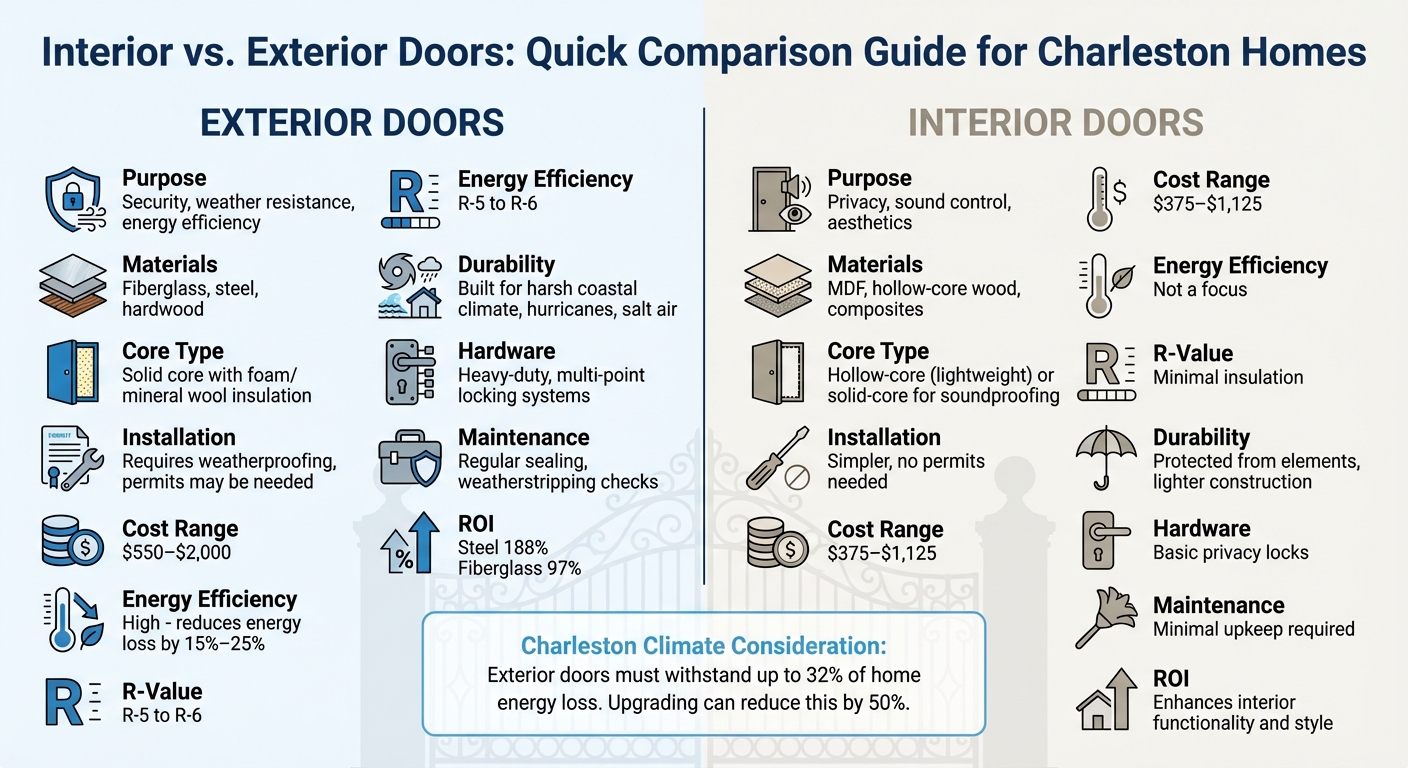
Interior vs Exterior Doors: Key Differences Comparison Chart
Main Differences Between Interior and Exterior Doors
Purpose and Function
Interior and exterior doors are designed for completely different tasks. Interior doors are all about creating privacy, dividing spaces, and managing sound. Some homeowners love the charm of French doors to let natural light flow between rooms, while others go for pocket or barn doors to save space in tighter areas.
Exterior doors, on the other hand, are built for protection. They need to keep your home secure, block out harsh weather, and help with energy efficiency. Especially in Charleston’s coastal climate, exterior doors face tough challenges like hurricanes, salty air, and high humidity. As the Lowe’s Editorial Team aptly states:
Exterior doors must withstand the weather and provide security. Interior doors are both decorative and functional.
The security difference is also worth noting. Exterior doors are equipped with heavy-duty hardware, multi-point locking systems, and reinforced frames to guard against break-ins. Meanwhile, interior doors typically rely on basic privacy locks.
These differences in purpose directly influence their materials and design.
Materials and Durability
When it comes to materials, interior doors are generally made from MDF, composites, lightweight woods, or glass. Many are hollow-core, which makes them more affordable and easier to install. However, solid-core options are available if you want better soundproofing.
Exterior doors, however, need to be far sturdier. Materials like steel, fiberglass, and hardwood are common choices, with fiberglass often being the go-to in the Lowcountry. Mr. Handyman of Charleston and Summerville explains:
Fiberglass is a good option when you want something that’s going to last long and keep thermal energy from escaping your house. It’s very durable and long-lasting, and it’s also resistant to damage from excess moisture, pests such as rodents and insects, decay and corrosion.
Steel provides top-notch security but demands regular upkeep to fend off rust caused by salty air. Wood, while undeniably elegant, requires consistent care to prevent warping and rot.
Unlike interior doors, which often have lightweight hollow cores, exterior doors are built solid with cores filled with foam or mineral wool for better insulation and strength. For example, a 1-1/2 inch thick exterior door without a window offers over five times the insulating value of a solid wood door of the same size. Most steel and fiberglass exterior doors boast R-values between R-5 and R-6, which is a big deal when it comes to keeping energy costs down during Charleston’s sweltering summers.
sbb-itb-cdbcc3e
Energy Efficiency and Installation Requirements
Energy Efficiency Features
While interior doors mainly focus on privacy and style, exterior doors play a much bigger role in a home’s energy efficiency – especially in Charleston’s hot and humid climate. In fact, outdated doors and windows can account for up to 32% of a home’s energy loss. By upgrading to energy-efficient exterior doors, you could cut that loss by as much as 50%, which might lower your monthly energy bills by 15%–25%.
Energy-efficient exterior doors are designed with features like polyurethane foam cores, high-performance weather seals, and magnetic weatherstripping to create an airtight barrier against heat transfer. If your door includes glass elements, choosing multi-pane Low‑E glass with argon gas fills and warm edge spacer systems can further reduce heat transfer. For Charleston’s climate, where cooling is a priority, opt for doors with a low Solar Heat Gain Coefficient (SHGC) to keep unwanted solar heat out.
Installation Steps and Requirements
Proper installation is just as important as the door itself when it comes to maximizing energy savings. Installing an exterior door in Charleston involves more than just hanging it – it requires weatherproof sealing, impact-resistant glass, and corrosion-resistant hardware to withstand the region’s coastal conditions. The process typically includes removing the old doorframe, ensuring the new frame is perfectly square, and using expanding foam or caulk to seal any gaps between the frame and rough opening to prevent air leaks. Additionally, the threshold must be properly sealed to block moisture before adding trim.
On the other hand, installing interior doors is much simpler. If the existing frame is in good condition, you can often just replace the door slab, a job that usually takes two to five hours. Key details to watch for include ensuring the door swings freely and maintaining standard clearances – typically 1/8 inch at the header and strike side, and 1/16 inch at the hinges.
One major difference with exterior doors in Charleston is the need for permits and compliance with regulations, especially for impact resistance in hurricane-prone areas. Homes in the Historic District face additional requirements, such as approval from the Board of Architectural Review for any exterior changes. Interior door installations, however, rarely involve such regulatory steps.
Finally, regular maintenance is crucial for keeping your exterior doors performing well. Check the weatherstripping yearly and replace it if it’s worn out to maintain a strong energy seal. If your entry gets several hours of direct sunlight, avoid installing a glass storm door, as it could trap heat and damage the main door.
Design Styles and Charleston Architecture
Interior Door Styles
Charleston’s rich architectural heritage inspires a variety of interior door designs that beautifully blend history with modern functionality. Classic panel doors, often found in traditional Georgian and Federal-style homes, are timeless choices. These doors, with their recessed or raised panels, add depth and elegance, making them versatile enough to suit both historic and contemporary interiors.
For Charleston’s iconic narrow Single Houses, space-saving solutions like pocket and bi-fold doors are ideal. These doors slide into hidden wall pockets or fold neatly, optimizing floor space without requiring significant wall alterations.
French doors are another favorite, especially for connecting spaces like home offices and dining rooms. They allow natural light to filter through, creating a sense of openness. As Icon Window & Door explains:
French door systems have two panels that open inward, creating a wide opening between two rooms. Sometimes, they contain glass inserts, which allow natural light to flow between both spaces.
In spaces like bathrooms or offices where privacy is key, glass panel doors with frosted or textured finishes strike the perfect balance between seclusion and light flow.
For a rustic touch, sliding barn doors bring charm and practicality, fitting well in farmhouse-inspired designs. Meanwhile, modern Shaker doors, with their clean lines and minimalist appeal, are perfect for contemporary coastal interiors. One Day Doors & Closets highlights their growing appeal:
Shaker doors have surged in popularity thanks to their minimalist look and clean, unadorned lines… perfect for contemporary homes or spaces aiming for a streamlined, clutter-free aesthetic.
While interior doors reflect style and function, Charleston’s exterior doors tell a story of tradition and resilience.
Exterior Door Styles
Charleston’s exterior doors are a harmonious blend of historic charm and coastal practicality. One unique feature is the "fake" front door – a hallmark of Charleston’s Single Houses. These doors, which open onto a piazza instead of directly into the home, offer privacy while maintaining the home’s historic facade. As photographer Lucy Cuneo notes:
I think that the elegant presentation of doorways with their plantings and architecture is the local people putting a friendly, welcoming, and social face on a design feature that is actually quite private and exclusive.
Traditional exterior door styles, such as Georgian and Colonial Revival, emphasize symmetry and grandeur. These often include central doors framed by pediments and classical details . Greek Revival entries add a stately touch with fluted columns in Doric or Ionic styles, while Federal-style doors are known for their understated elegance, featuring elliptical transoms or fanlights .
Modern exterior doors are built to withstand Charleston’s challenging climate. Materials like fiberglass, steel, and clad finishes mimic the look of historic wood while resisting the effects of humidity, salt air, and heat. This "Neotraditional" approach combines modern construction techniques with classic design elements, such as Greek Revival columns or Federal-style motifs, to preserve Charleston’s architectural legacy.
The Modern Farmhouse trend is also gaining traction, blending rustic details with contemporary features like expansive porches, offering a fresh perspective on Lowcountry living.
Color trends for exterior doors in Charleston have evolved dramatically. Since Dorothy Porcher Legge famously painted Rainbow Row pink in 1931 to rejuvenate East Bay Street, vibrant colors have become a hallmark of Charleston’s aesthetic. From soft pastels to bold blues, these hues reflect the city’s sunny and cheerful spirit . These looks are often complemented by classic gas lanterns and hardware in finishes like bronze or black, adding timeless elegance to Charleston’s historic homes .
Cost Factors for Interior and Exterior Doors
Initial Costs and Customization
The cost of installing interior doors typically ranges from $375 to $1,125, while exterior door installations are pricier, falling between $550 and $2,000. In Charleston, the average cost for an exterior door installation is about $1,175, with most projects landing between $525 and $1,800.
Material selection plays a big role in pricing. For interior doors, hollow core options cost between $30 and $400, while solid wood models range from $160 to $590. Exterior doors, on the other hand, use materials like steel ($150–$1,400), fiberglass ($150–$3,000), or premium wood ($500–$3,000). In Charleston’s coastal climate, fiberglass stands out as a durable yet cost-effective choice.
Customization adds to the expense. For example, French doors can cost anywhere from $600 to $5,800, and pocket doors range between $800 and $3,500. Adding sidelights or transoms to an exterior entry could increase the price by $1,600 to $4,600. Hardware costs also vary widely, with basic options priced at $10 to $300, while smart locks can go up to $300.
Labor costs typically account for 30% to 35% of the total installation expense. Installing a standard interior door takes about 2 to 5 hours, while exterior doors may require a full day, especially if structural adjustments or reframing are necessary. Reusing existing hardware can cut costs by $50 to $400, and replacing multiple doors at once often leads to contractor discounts.
These initial costs lay the groundwork for understanding the long-term benefits and maintenance needs of your doors.
Long-Term Value and Maintenance
While exterior doors may come with a higher upfront price tag, they can deliver long-term savings through improved energy efficiency. Insulated steel and fiberglass doors, for instance, boast R-values of R-5 to R-6, offering more than five times the insulating power of solid wood. This translates to lower energy bills, especially in Charleston’s warm, humid climate, where doors with a low Solar Heat Gain Coefficient (SHGC) and low U-factor ratings help keep cooling costs in check.
Maintenance demands vary based on the material. Wood doors require the most care, including regular sealing and occasional paint touch-ups to prevent rot in Charleston’s salty, humid air. Fiberglass and steel doors, while more durable, are harder to repair if damaged. HomeAdvisor highlights fiberglass as a top choice for sun-exposed areas:
If your entry bakes in direct sun, fiberglass is the clear winner. The material shrugs off extreme heat, stays energy-efficient, and won’t warp or fade the way wood sometimes can.
Interior doors are easier to maintain since they’re not exposed to the elements or equipped with security hardware. For exterior doors, small fixes like replacing weatherstripping cost $10 to $50, and frame repairs typically range from $9 to $22 per square foot. High-quality fiberglass doors, in particular, can last around 20 years in Charleston’s heat, making them a wise investment.
As Caroline Gilbert, Director of Content & Editorial at Angi, notes, premium doors can also enhance your home’s resale value:
High-quality doors can increase your home’s resale value. If you plan to sell your home in the near future, a premium door material like solid wood or steel can make a positive impression on potential buyers.
Why Choose Icon Window & Door for Your Door Installation
Quality Craftsmanship and Custom Solutions
Icon Window & Door, a family-owned business established in 2020, brings over 50 years of combined experience in construction and project management to Charleston. Their "white-glove" service ensures homeowners are supported every step of the way – from selecting the right products to precise, professional installation. Partnering with trusted manufacturers like Sun Windows and Doors, Masonite, Rogue Valley Doors, and TruStile, they deliver doors that are built to withstand the challenges of coastal living.
Whether you’re looking for a historic entryway or sleek modern French doors, Icon offers custom options in wood, fiberglass, steel, vinyl, and clad finishes. Their installations prioritize security, featuring reinforced door frames, durable locksets, and long strike plate screws for added protection. As one happy customer shared, "Icon Window and Door is the best quality in the Lowcountry. I always recommend this company to friends and family."
Charleston Expertise and Warranties
Icon Window & Door leverages its deep understanding of Charleston’s unique climate to deliver solutions tailored to the area. Their doors are designed to handle intense heat, high humidity, salt air, and powerful coastal storms. To make the process easier, they provide free consultations and site visits, helping homeowners choose the perfect doors for their needs.
Every installation is backed by a one-year workmanship warranty, giving you peace of mind. The company has earned a consistent 5/5 star rating from verified customers who value their reliability and ability to source custom sizes that are often hard to find. With competitive pricing and flexible payment options – including ACH, checks, credit cards, and PayPal – you’ll find exceptional value without compromising quality.
Conclusion
Choose doors that align with your home’s specific needs. Exterior doors should take center stage when focusing on security and energy efficiency. For instance, steel doors offer a 188% ROI, while fiberglass entryways provide a 97% ROI – making exterior upgrades a smart investment for both protection and long-term value. On the other hand, interior doors focus on enhancing the comfort and functionality of your living spaces.
Interior doors are best suited for goals like improving privacy, reducing noise in busy households, or maximizing space in areas like closets and narrow hallways. While they don’t face the same environmental challenges as exterior doors, they play a key role in creating practical and inviting interiors. This balance is especially important for Charleston homeowners, who often juggle open-concept layouts with the need for private spaces like home offices.
Charleston’s unique climate also influences door choices. Exterior doors must handle challenges like pests and severe storms, while interior doors prioritize style and usability. For interior projects, plan renovations during Charleston’s mild winter months, such as January and February, to avoid the busier renovation seasons.
Ultimately, your door selection should reflect both your needs and Charleston’s architectural charm. Whether you’re upgrading a historic entryway or adding French doors to brighten your space, thoughtful planning and professional installation will ensure your doors enhance your home’s functionality and value for years to come.
FAQs
What materials are best for exterior doors in Charleston’s weather conditions?
For Charleston’s hot, humid, and storm-filled weather, fiberglass, insulated steel, and composite (clad) doors stand out as smart options. These materials are built to last, resist warping and corrosion, and help keep energy costs in check by managing indoor temperatures and humidity effectively.
Fiberglass doors are a favorite for their ability to replicate the natural beauty of wood without the high maintenance. Insulated steel doors excel in providing top-tier security and thermal efficiency, while composite doors offer a blend of strength and a sleek, contemporary design. Opting for any of these materials means your door can handle Charleston’s salty air, heavy rains, and temperature swings, all while staying functional and looking great for years.
What are the best ways to make my home’s doors more energy-efficient?
Improving the energy efficiency of your home’s doors can make a big difference in reducing energy costs and keeping your home comfortable. Start by sealing any gaps or cracks. Adding weather-stripping around the door frame and installing a door sweep at the bottom can block drafts effectively. You can also use caulk to seal any cracks around the door to minimize energy loss.
If you’re considering replacing your door, go for options designed with insulation in mind. Insulated steel or fiberglass doors are more efficient compared to traditional wood doors. For doors with glass panels, choose those with low-E glass, which helps reduce heat transfer while still letting in natural light. Make sure to check for the ENERGY STAR label – this ensures the door meets energy efficiency standards.
The installation process is just as important. Pre-hung doors that fit snugly into the frame create a tight seal, preventing air leaks. By sealing gaps, choosing insulated materials, and ensuring proper installation, you can reduce energy use significantly, especially in Charleston’s warm, humid climate.
What are the key differences between fiberglass and steel doors, and which one should I choose?
Fiberglass doors are an excellent choice if you’re after strength and minimal upkeep. They’re designed to resist warping, rotting, and rusting, which makes them a smart pick for humid areas like Charleston. Plus, they provide great insulation, which can help keep energy bills in check. With a wide range of styles and finishes available, it’s easy to find one that matches your home’s aesthetic. That said, they often come with a higher upfront cost and can be trickier to install.
Steel doors, by contrast, are generally more budget-friendly and offer impressive durability, making them a solid option for security. They’re also easier to install and maintain. However, they can dent over time and may rust if not properly maintained. In terms of design, steel doors typically have fewer options compared to fiberglass.
When making your decision, think about what matters most to you – your budget, the climate you live in, and your design preferences. If energy efficiency and a variety of styles are at the top of your list, fiberglass might be the way to go. But if you need a secure, economical solution, steel doors could be a better fit.