Charleston’s climate and architectural charm demand front doors that balance durability and style. High humidity, salty air, and hurricane risks make material choice critical. Fiberglass doors stand out for their resistance to warping, rust, and rot, while steel offers strength and security. Wood doors provide classic appeal but require significant maintenance to handle the area’s conditions.
Key Takeaways:
- Top Materials: Fiberglass (low maintenance), steel (durable, secure), wood (high upkeep, elegant).
- 2026 Trends: Neutral tones, textured glass for privacy, and double doors with glass panels.
- Energy Efficiency: Insulated cores, Low-E glass, and weatherproof seals reduce cooling costs.
- Installation Tips: Precision measurements and corrosion-resistant materials ensure longevity.
For Charleston, fiberglass doors are a practical choice, combining resilience with minimal upkeep. Steel doors are excellent for security, while wood suits those prioritizing aesthetics over maintenance.
How Charleston’s Climate Affects Front Door Selection
Charleston’s humid subtropical climate presents unique challenges for front doors, with conditions that can wear down materials quickly if they’re not built for the environment. Summers often bring temperatures above 90°F, coupled with high humidity levels year-round. Add ocean spray and heavy hurricane rains into the mix, and you’ve got a recipe for testing a door’s durability to its limits.
Humidity plays a big role in causing problems, especially for wooden doors. Wood tends to absorb moisture, leading to swelling, which can make the door stick or warp. Over time, this moisture encourages mold growth and wood rot, weakening the door’s structure.
Salt-laden air is another culprit, speeding up the corrosion of metal components. Door hardware can rust quickly, and steel doors without proper coastal-grade finishes often deteriorate, compromising their strength.
On top of that, Charleston’s temperature swings can cause materials to expand and contract. This constant movement creates gaps that let conditioned air escape, which can drive up energy costs. For homes in this area, it’s essential to choose materials specifically designed to handle these conditions.
During hurricane season, doors face even tougher demands. Impact-resistant glass and reinforced frames are a must to withstand flying debris and meet stringent coastal building codes. A poorly designed door can leave your home vulnerable during storms, making it critical to select one built to handle Charleston’s unique climate challenges.
sbb-itb-cdbcc3e
2026 Front Door Design Trends in Charleston
Charleston’s front door trends for 2026 perfectly balance style and practicality, tailored to meet the city’s coastal climate and aesthetic preferences. Homeowners are leaning toward warm neutral tones – think creams, beiges, terracotta, and muted coral. These sun-kissed shades complement the area’s historic brickwork and soft coastal light, creating a natural, harmonious look. A standout trend is color drenching, where both the door and its surrounding trim are painted in the same monochromatic shade, delivering a sleek, modern vibe.
Material preferences are evolving too. While wood remains a classic choice for its timeless charm, Charleston’s humid, salty air is driving a shift toward more durable options like steel, iron, and fiberglass.
"Wood has that warm, natural look people love, but it can swell or fade faster in regions with lots of humidity or salty air." – Scarlet Fretwell, Design Studio Assistant at Clark Hall Doors & Windows
The modern farmhouse aesthetic is also getting a refresh, blending its rustic appeal with contemporary materials like matte black steel and slim, clean lines. These material shifts are influencing key design trends in Charleston.
Steel Doors with Vertical Panels
Steel doors featuring vertical paneling are becoming a popular choice for Charleston entryways. These minimalist panels add subtle texture while drawing inspiration from historic barn doors. Steel’s durability makes it ideal for withstanding the city’s coastal storms, while the design pairs beautifully with traditional white siding or brick exteriors. This combination delivers both visual appeal and the strength needed for Charleston’s unique challenges.
Double Doors with Glass Panels
Double doors with large, insulated glass panes are another favorite. These French-inspired designs flood entryways with natural light, creating a bright and welcoming atmosphere while also maintaining energy efficiency during South Carolina’s hot summers. Beyond aesthetics, these doors offer practical benefits like easier furniture movement and a seamless connection between indoor and outdoor spaces.
Textured Glass for Privacy
For homes in Charleston’s historic neighborhoods, where entryways often face busy streets or sidewalks, textured glass is a practical and stylish solution. Options like reeded, ribbed, or frosted glass allow sunlight to filter through while maintaining privacy. Patterns such as "Blanca" or "Rain" strike the perfect balance between function and elegance, giving homeowners the light-filled look of glass-paneled doors without compromising on discretion.
Best Materials for Front Doors in Charleston
When choosing a front door for your Charleston home, it’s crucial to consider materials that can handle the area’s humidity, salty air, and intense summer heat. Each material has its strengths and maintenance requirements, so here’s a breakdown to help guide your decision.
Steel and Iron Doors
Steel and iron doors are built to endure Charleston’s challenging coastal climate. They provide excellent security and are highly resistant to storms, making them a smart choice during hurricane season. To keep them in top shape, apply a rust-prevention spray once a year and dry them thoroughly after heavy rain. For added durability, opt for thermally broken doors – this feature reduces heat transfer, helping to keep your home cooler during the sweltering South Carolina summers. When selecting hardware, go for Grade 316 stainless steel or solid brass, as these materials are better suited to resist corrosion from salty air.
Fiberglass Doors
Fiberglass doors are a low-maintenance alternative that eliminates the worry of rust or corrosion. Perfectly suited for Charleston’s humid environment, fiberglass won’t absorb moisture, warp, rot, or rust. These doors also offer energy efficiency thanks to their insulated cores.
"Fiberglass doors are ideal because they tend to be mid-range in price and won’t shrink, warp out of shape, or rust, resolving all the high-humidity risks." – Sandy Baker
If you love the appearance of wood but want to avoid the upkeep, fiberglass doors with woodgrain textures like mahogany, oak, or fir are a great option. They typically last 15 to 20 years, offering a reliable and budget-friendly long-term solution.
Wood Doors with Protective Coatings
Wood doors bring a timeless, classic charm, but they require more care to combat Charleston’s humid conditions. Without protection, wood can absorb moisture, leading to swelling, warping, or rot. Hardwoods like cedar or redwood are better choices, as their natural properties resist moisture more effectively. To protect your investment, apply high-performance coatings and plan for regular sealing or repainting to shield the door from UV rays and humidity. For a balance of beauty and durability, consider aluminum-clad wood doors. These combine the aesthetic appeal of a wood interior with a protective aluminum exterior, reducing maintenance needs. While wood doors demand more upkeep, they remain a top choice for homeowners who value their traditional elegance.
Energy-Efficient Features for Charleston Front Doors
Charleston’s hot and humid summers, with temperatures often soaring past 90°F, make energy-efficient front doors a practical necessity. These doors can help lower cooling costs while keeping your home comfortable. Here are some important features to look for when choosing an energy-efficient door:
Insulated cores are a game-changer for reducing heat transfer. Doors with polyurethane foam insulation deliver R-values between R-5 and R-6, offering over five times the insulation of a solid wood door of the same thickness. This type of core acts as a thermal barrier, which could save you anywhere from $150 to $400 annually on energy bills.
For doors with glass panels, Low-E (low-emissivity) coatings are essential. These thin metallic layers reflect infrared heat while still letting in natural light, brightening your entryway without adding extra heat. In Charleston’s cooling-heavy climate, prioritize a Solar Heat Gain Coefficient (SHGC) of 0.23 or lower. Many high-performance doors also use Argon or Krypton gas fills between glass panes to further minimize heat transfer.
Weather stripping is another critical feature, sealing your door tightly to keep cool air in and humid, salty air out. Magnetic weather stripping – like what you’d find on a refrigerator door – provides one of the most effective seals available. Inspect these seals annually, especially after Charleston’s intense summer storms, and replace them if you notice cracks or wear. Damaged weather stripping can reduce energy efficiency by as much as 20–40%.
When shopping for a new front door, look for the ENERGY STAR label tailored to the Southern climate zone. ENERGY STAR–certified doors can lower energy bills by an average of 12%. Plus, you may qualify for federal tax credits covering 30% of the door’s cost – up to $250 per door – through 2032. Don’t forget to check the NFRC label for U-factor and SHGC ratings to ensure the door is optimized for Charleston’s specific climate needs.
Front Door Material Comparison
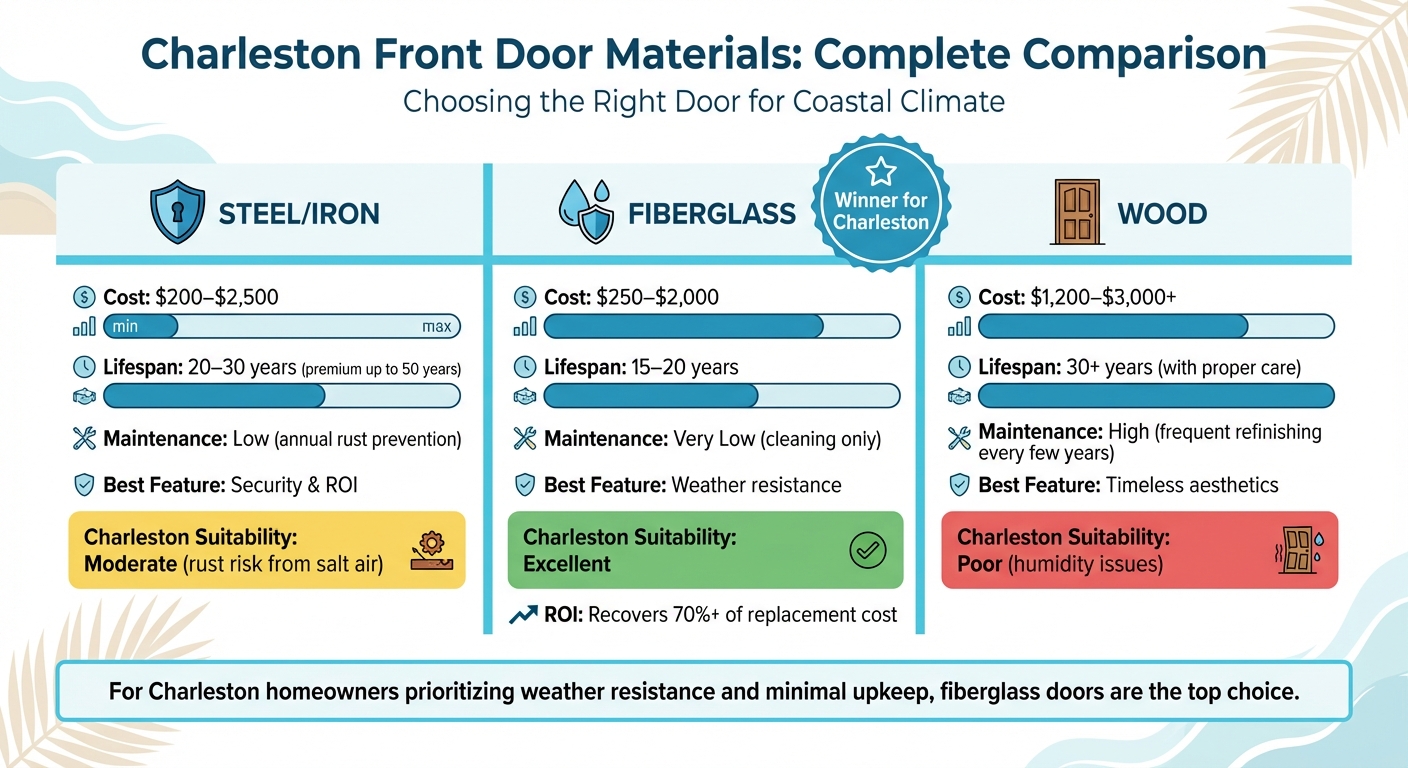
Charleston Front Door Materials Comparison: Cost, Lifespan & Maintenance
When choosing a front door, balancing cost, durability, and upkeep is key – especially in Charleston’s coastal climate. Here’s a closer look at how steel, fiberglass, and wood doors stack up.
Steel Doors
Steel doors are a cost-effective option, with prices ranging from $200 to $2,500. They provide top-notch security and are highly resistant to forced entry. However, Charleston’s salty air can cause rust if the protective coating wears off. On average, steel doors last 20–30 years, with premium models reaching up to 50 years, making them a solid long-term investment.
Fiberglass Doors
Fiberglass doors, priced between $250 and $2,000, are a great match for Charleston’s humid weather. They resist warping, rotting, and rusting, making them a low-maintenance option. According to Tim Hand of Statewide Remodeling, fiberglass is one of the most durable choices for extreme climates. These doors require minimal upkeep – just occasional cleaning – and offer excellent energy efficiency. They typically last 15–20 years and can recover over 70% of their replacement cost in home value.
Wood Doors
Wood doors are on the pricier side, starting at $250–$500 for unfinished options and $1,200–$3,000 or more for ready-to-install versions. While their classic look is unmatched, they require consistent maintenance to handle Charleston’s humid conditions.
"Wood entry doors also require regular maintenance – sanding and re-staining or painting every few years – or they can warp and rot from the natural elements".
With proper care, wood doors can last over 30 years, but their high upkeep makes them less practical for coastal areas.
Here’s a quick comparison to help you decide:
| Material | Cost | Lifespan | Maintenance Needs | Best Feature | Charleston Suitability |
|---|---|---|---|---|---|
| Steel/Iron | $200–$2,500 | 20–30 years | Low (rust prevention) | Security & ROI | Moderate (rust risk) |
| Fiberglass | $250–$2,000 | 15–20 years | Very Low (cleaning only) | Weather resistance | Excellent |
| Wood | $1,200–$3,000+ | 30+ years | High (frequent refinishing) | Timeless aesthetics | Poor (humidity issues) |
For Charleston homeowners prioritizing weather resistance and minimal upkeep, fiberglass doors emerge as the top choice.
Icon Window & Door Front Entry Solutions
Icon Window & Door brings over 50 years of construction and project management expertise to homeowners in Charleston. Since 2020, the company has focused on creating coastal-ready front door solutions designed to endure the region’s high heat, humidity, salt air, and tropical storms.
With decades of experience, Icon tailors every detail to complement Charleston’s architectural diversity. Homeowners can select from a wide range of door sizes, custom designs, and hardware finishes like bronze, black, chrome, and brass. This ensures compatibility with various home styles, from historic single houses and Colonial residences to modern industrial designs and cozy Lowcountry cottages.
Each door is crafted for energy efficiency, featuring weatherproof seals, polyurethane cores, triple glazing, and thermally broken aluminum frames. These elements work together to lower heating and cooling costs while meeting ENERGY STAR® standards.
In addition to energy efficiency, Icon places a strong emphasis on security. Their doors incorporate advanced technology and reinforced hardware, including electronic locks with fingerprint access, RFID scanning, and app-controlled locking systems. Extra-long screws, heavy-duty strike plates, and ADA-compliant lever handles with automatic door closers further enhance both security and accessibility.
Every installation is supported by a one-year workmanship warranty. Homeowners receive personalized consultations, expert guidance on product selection, and precise fitting to ensure a smooth and reliable upgrade. Free estimates and consultations are available to help Charleston residents find the perfect front door solution tailored to their home’s style and the local climate.
Front Door Installation Tips for Charleston Homes
Installing a front door in Charleston isn’t just about picking the right style or material – it’s also about ensuring it’s installed correctly to handle the region’s unique conditions. With Charleston’s climate and historic architecture, precise measurements and proper techniques are non-negotiable.
Start by measuring the width of the door panel at the top, center, and bottom, using the smallest measurement. Do the same for the height at the left, center, and right. These steps are especially important for Charleston’s historic homes, where openings can vary slightly. For a custom fit, professionals measure down to 1/8 inch.
Next, check the jamb depth, which is the distance from the back of the exterior trim to the back of the interior trim. This ensures the door fits the wall’s thickness, which is typically 4 9/16", 5 9/16", or 6 9/16". For the most accurate results, remove the interior trim and measure the wall studs and opening dimensions at three different points.
"Door installation may sound simple, but it often requires a lot of tricky measurements and the ability to think on your feet to come up with solutions for unexpected problems." – Mr. Handyman of Charleston and Summerville
Charleston’s coastal environment adds another layer of complexity. Professional installers use marine-grade sealants, corrosion-resistant fasteners, and advanced flashing techniques to protect against salt air and high humidity. Without these precautions, doors in coastal areas may need replacing every 5 to 7 years. Once measurements are finalized, the installation itself typically takes 2 to 4 hours.
When hiring an installer, ensure they provide a written workmanship guarantee and have experience with materials designed for high UV exposure and salty environments. Icon Window & Door, for example, offers free consultations and estimates, along with a one-year workmanship warranty. This kind of expertise ensures Charleston homeowners get a door that not only looks great but also stands up to the challenges of coastal living.
Conclusion
Selecting the perfect front door for your Charleston home starts with understanding how the local climate – marked by heat, humidity, salt air, and storms – affects different materials. Fiberglass and steel are often top choices due to their proven ability to withstand coastal conditions. If you prefer the timeless charm of wood, opt for hardwood varieties treated with protective coatings designed specifically for coastal environments.
Once you’ve chosen a durable material, it’s important to consider key performance features. Prioritize energy efficiency and storm protection. Features like Low-E glass and marine-grade weatherstripping can help lower cooling costs during Charleston’s sweltering summers. At the same time, impact-resistant glass and reinforced frames offer essential protection during hurricane season. Together, these elements ensure your door is ready to handle the region’s unique challenges.
"Our products are designed to withstand Charleston’s heat, humidity, salt air, and storms." – Icon Window & Door
Proper installation is just as critical as material selection. Precision measurements, the use of coastal-grade sealants, and corrosion-resistant fasteners ensure your door functions reliably year after year despite Charleston’s harsh conditions. Icon Window & Door brings over 50 years of combined expertise to every installation, offering a one-year workmanship warranty for added peace of mind. Their team provides complimentary consultations and free estimates to guide you through material options and custom solutions.
FAQs
Do I need an impact-rated front door in Charleston?
Installing an impact-rated front door in Charleston is a smart choice. These doors comply with coastal building codes and are built to handle hurricane debris and strong winds. Designed for the area’s tough weather, they help keep your home protected and secure during severe storms.
What front door material holds up best near the coast?
Fiberglass doors stand out as the best choice for coastal regions. They are specifically designed to resist salt air, high humidity, and corrosion, which are common challenges in these areas. This resilience ensures they maintain their performance and appearance over time, even in tough coastal conditions.
Which energy ratings should I check before buying a door?
When evaluating doors, pay attention to the U-factor and Solar Heat Gain Coefficient (SHGC) ratings. These are certified by the National Fenestration Rating Council (NFRC) and provide a reliable way to gauge a door’s energy performance. A lower U-factor means the door offers better insulation, keeping heat from escaping. Meanwhile, the SHGC tells you how much solar heat the door allows inside – important for managing indoor temperatures based on your climate.