Fire doors are a critical safety feature in buildings, designed to slow the spread of fire and smoke, giving occupants time to evacuate. In South Carolina, fire door regulations are governed by the 2021 South Carolina Fire Code (SCFC) and 2021 South Carolina Building Code (SCBC), which require compliance with national standards like NFPA 80 and NFPA 105. These standards cover installation, maintenance, and inspection requirements to ensure fire doors perform effectively during emergencies.
Key Takeaways:
- Annual Inspections Required: Property owners must work with a window and door supplier to inspect fire doors yearly, per NFPA 80, and maintain detailed records.
- Fire Door Ratings: Ratings (20, 45, 60, or 90 minutes) determine how long a door resists fire, based on tests like ASTM E119 or UL 263.
- Material Standards: Steel, wood with mineral cores, and fire-rated composites are common materials. All components must carry fire labels.
- Hardware Requirements: Fire doors must have self-closing devices, positive latching mechanisms, and signage like "FIRE DOOR – KEEP CLOSED."
- Legal Compliance: Missing labels, damaged doors, or improper maintenance can result in fines ranging from $500 to $5,000 per violation.
By following these regulations, property owners can ensure compliance, protect lives, and prevent structural damage during a fire.
Fire Door Ratings and Classifications
South Carolina Fire Door Ratings and Applications Guide
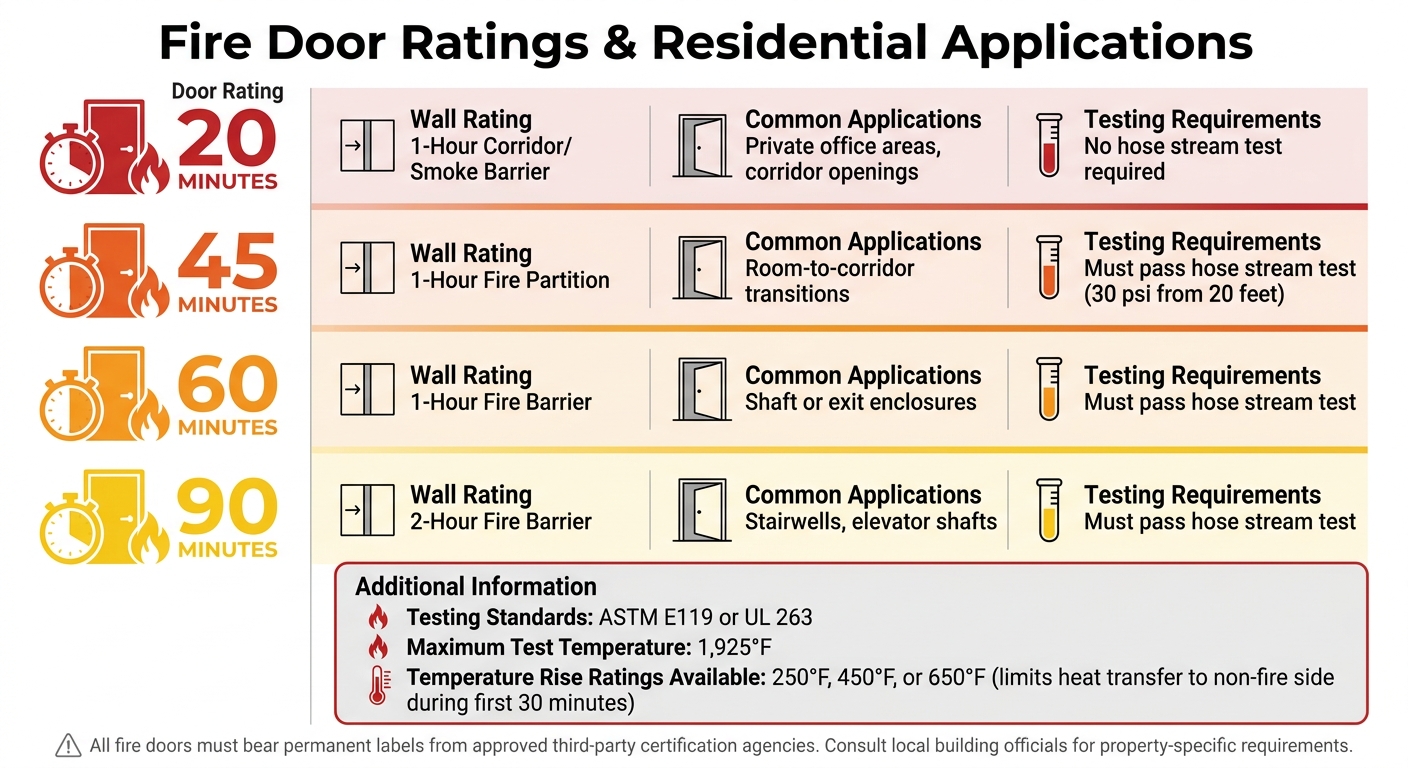
Fire door ratings indicate how long a door can endure fire exposure under standardized testing. Knowing these ratings helps homeowners in South Carolina select fire doors that comply with local building codes for specific areas of their homes.
How Fire Resistance Ratings Work
In South Carolina, fire resistance ratings are established through standardized tests like ASTM E119 or UL 263. These tests expose doors to temperatures as high as 1,925°F for up to 180 minutes to evaluate their performance.
"A fire-resistance rating of building elements, components or assemblies shall be determined by the test procedures set forth in ASTM E119 or UL 263." – South Carolina Building Code
Fire door ratings commonly used in homes include classifications of 20, 45, 60, and 90 minutes. Doors rated 45 minutes or higher must pass a hose stream test, which involves blasting the door with water at 30 psi from 20 feet away after fire exposure to ensure it maintains structural integrity. However, 20-minute doors are not required to undergo this test. Some doors also have a temperature rise rating (250°F, 450°F, or 650°F), which limits heat transfer to the non-fire side during the first 30 minutes.
These ratings are essential for ensuring compliance with local codes and guide homeowners in choosing the right fire doors for their needs.
Selecting the Correct Rating for Residential Use
The fire door rating you need depends on the wall assembly it protects. For example:
- 20-minute doors: Used in 1-hour fire-rated corridors or smoke barriers, such as private office areas or corridor openings. These are common locations for specialized interior doors in multi-use residential structures.
- 45-minute doors: Found in 1-hour fire partitions, often separating rooms from corridors.
- 60-minute doors: Installed in 1-hour fire barriers, like those in shafts or exit enclosures.
- 90-minute doors: Required for 2-hour-rated walls in areas like stairwells or elevator shafts.
| Door Rating | Wall Rating | Common Residential Application |
|---|---|---|
| 20 Minutes | 1-Hour Corridor/Smoke Barrier | Private office areas, corridor openings |
| 45 Minutes | 1-Hour Fire Partition | Room-to-corridor transitions |
| 60 Minutes | 1-Hour Fire Barrier | Shaft or exit enclosures |
| 90 Minutes | 2-Hour Fire Barrier | Stairwells, elevator shafts |
For exterior walls in residential (Group R) buildings, a 1-hour fire-resistance rating is often necessary when the fire separation distance is less than 30 feet. Always consult local building officials to confirm your property’s classification and any specific exceptions.
All fire doors must bear a permanent label from an approved third-party certification agency. If the label is missing or has been painted over, property owners must obtain a replacement label from an approved certification organization to remain compliant.
sbb-itb-cdbcc3e
Material Requirements for Fire Doors
Approved Materials and Construction Methods
Choosing the right materials is key to meeting the fire resistance ratings mentioned earlier. In South Carolina, all materials used in fire-resistance-rated assemblies must undergo testing based on ASTM E119 or UL 263 standards. The most commonly used materials for fire doors include steel, solid wood with mineral cores, and fire-rated composites.
Steel doors are inherently non-combustible and can achieve fire ratings of up to 3 hours (180 minutes). These doors often feature rigid honeycomb or polystyrene cores, which enhance both structural integrity and thermal performance. Wooden fire doors, on the other hand, rely on a thin veneer covering a mineral core to provide fire resistance.
"Wooden doors are only fire-resistant when the wood is only a thin layer on the surface, covering the mineral core underneath – the real source of its strength." – Vortex Doors
Noncombustible materials must meet the testing criteria of ASTM E136 or ASTM E2652. Fire-rated glazing is also allowed in door assemblies if it passes ASTM E119 or UL 263 testing and includes a permanent certification label. Additionally, surface finishes on noncombustible materials can be up to 0.125 inch (3.18 mm) thick, as long as the flame spread index does not exceed 50 when tested under ASTM E84 or UL 723.
How Materials Affect Fire Resistance
The performance of materials under fire conditions plays a significant role in determining the overall fire rating of a door. The core material is the primary factor in fire endurance: steel’s non-combustible nature supports ratings between 90 and 180 minutes, while wooden doors depend entirely on their mineral cores, as the outer veneer provides minimal fire protection.
Temperature-rise doors are a specialized type designed to limit the transfer of heat. These doors are required to ensure the non-fire-exposed side does not exceed 450°F above ambient temperature within the first 30 minutes of fire exposure. This feature is particularly crucial for stairwells and exit enclosures, where it’s essential to protect occupants not just from flames but also from intense heat. These material standards align with South Carolina’s building codes, ensuring compliance and enhancing occupant safety.
Every component of the door assembly – including frames, hinges, and hardware – must carry fire labels that match the door’s fire rating. For maintenance purposes, any field-applied labels must adhere to the guidelines of an approved third-party certification organization.
Hardware and Installation Requirements
Required Hardware Components
Fire doors in South Carolina need specific hardware to function properly during a fire. One key requirement is steel-bearing hinges that match or exceed the door’s fire rating. For instance, a 90-minute-rated door must use hinges rated for 90 minutes as well.
Each fire door must also have a self-closing device and a positive latching mechanism to ensure it closes automatically and stays securely shut under fire pressure. Swinging fire doors are particularly important – they must be able to close fully and latch without any manual help, even when opened completely.
For doors designed to stay open during normal use, hold-open devices are allowed but under strict guidelines. These devices must include either a heat-sensitive fusible link or an automatic closer triggered by smoke detection. Fusible links must not exceed a rating of 135°F (57°C). On egress paths, electromagnetic hold-open devices require open strike backs to ensure the latch engages when the magnet releases.
Fire doors must also have permanent signage with letters at least 1 inch (25 mm) high. Doors that are typically closed should display "FIRE DOOR – KEEP CLOSED", while those held open must read "FIRE DOOR – DO NOT BLOCK". Additionally, double swinging fire doors not located on egress paths need astragals – overlapping strips that cover the gap between the doors and act as a smoke barrier.
Once the hardware is installed, proper installation and clearance standards are essential to ensure safety and compliance.
Proper Installation and Clearance Standards
The right installation ensures fire doors operate safely and maintain their functionality. A fully open fire door must not reduce the required egress width by more than 7 inches (178 mm). During its swing, the door cannot decrease the necessary width by more than half. Door closers and stops can extend into the headroom, but vertical clearance must remain at least 78 inches (1,981 mm).
Fire doors must always be free of obstructions and fully operational. Remove items like chains, door stops, drapery, or any equipment that interferes with the door’s operation or closing mechanism. Surface-mounted latch release hardware is exempt from the 7-inch encroachment rule if it’s installed between 34 inches (865 mm) and 48 inches (1,219 mm) above the floor on the side of the door that faces away from the wall when open.
Annual testing is required for all sliding, rolling, and other non-swinging fire doors. Additionally, visual inspections of fire-resistance-rated components should be conducted regularly, with detailed records maintained. If a hold-open device or automatic closer malfunctions, the door should remain closed until repairs are complete.
Lastly, all components – frames, hinges, locks, and latches – must be tested as a complete assembly to confirm they can withstand extreme heat without warping or cracking. Each part should have fire labels matching the door’s fire rating, allowing inspectors to verify compliance with South Carolina’s fire door standards.
For expert guidance on fire door hardware and installation in South Carolina, reach out to Icon Window & Door.
Inspection, Maintenance, and Compliance
Fire Door Inspection Checklist
In South Carolina, the Fire Code mandates annual visual inspections of all fire-resistance-rated constructions, including every fire door assembly. These inspections must align with NFPA 80 standards to ensure fire doors are functioning as intended.
Start by verifying that fire-rating labels are clear, legible, and unaltered. Examine the door and frame for damage or openings, and ensure any glazing or vision light frames are securely in place.
Pay close attention to clearances. Gaps should measure 1/8 inch at the top and sides and no more than 3/4 inch at the bottom. Test the self-closing device to confirm it closes the door fully and automatically. For double doors, check that the coordinating mechanism ensures both doors close in the correct sequence.
Inspect gasketing and seals to confirm they are intact and free from paint. Look for unauthorized modifications that might interfere with the door’s operation. Ensure required signage is present and clearly visible. Signs should have letters at least 1 inch high, displaying messages like "FIRE DOOR – KEEP CLOSED" or "FIRE DOOR – DO NOT BLOCK."
For sliding and rolling fire doors, annual testing is also required to confirm proper operation and complete closure. During drop tests, the door’s closure speed should fall between 6–24 inches per second. As Shawn Mahoney, Technical Services Engineer at NFPA, explains:
"NFPA 80 requires that fire doors be inspected and tested immediately after the initial installation and then at a minimum annually after that."
All inspection results should be carefully documented to support ongoing maintenance efforts.
Ongoing Maintenance and Record-Keeping
After completing inspections, maintaining detailed records is a critical step toward compliance. Create an inventory of all fire-rated door assemblies, and document inspections, repairs, and maintenance activities. These records should be accessible for review by the Authority Having Jurisdiction.
When repairs are made, record the date, door location, materials used, and the technician’s name. If a fire door fails any part of the inspection checklist, it must be repaired or replaced immediately. According to the Fire Door Inspection Scheme:
"76% of fire doors fail professional inspections – often because property managers don’t know what to look for."
Non-compliance can lead to fines ranging from $500 to $5,000 per violation, especially in areas enforcing NFPA 80 standards.
Improper maintenance can create unsafe conditions under state codes, potentially leading to immediate corrective action by fire officials. To supplement annual inspections by professionals, facility staff should conduct monthly visual checks to catch issues like damaged seals or propped-open doors early.
If a label is missing or painted over, any replacement label must meet the standards of an approved third-party certification organization. Include the certification in your compliance records. To stay organized, centralize all documentation – whether digital or physical – in a compliance folder. This ensures you can demonstrate ongoing adherence to South Carolina’s fire door requirements.
Conclusion: Fire Door Compliance in South Carolina
Complying with fire door regulations in South Carolina means adhering to legal requirements and maintaining consistent upkeep. These efforts are grounded in fire door ratings, material specifications, and hardware standards outlined earlier. Under the 2021 South Carolina Fire Code – effective as of January 1, 2023 – property owners are required to maintain an inventory of all fire-rated door assemblies, conduct annual inspections, and ensure that every fire door operates as designed.
Fire doors must close automatically and latch securely. They cannot be blocked, wedged open, or altered in ways that affect their performance. Any component that fails to meet these standards is considered unsafe and must be addressed immediately.
It’s essential to document all inspections, repairs, and maintenance in a permanent, easily accessible log. For specialized doors, such as horizontal or vertical sliding models, annual testing should confirm proper closure and operation. If hold-open devices or automatic closers malfunction, the door should remain closed until repairs are made.
The NFPA 80 standard provides detailed guidance on fire door maintenance, while NFPA 105 focuses on smoke and draft control doors. These standards ensure that fire-resistance ratings are preserved and that critical safety features – like self-closing mechanisms and proper clearances – work effectively during emergencies. By strictly adhering to these standards, property owners not only meet legal obligations but also protect lives and property.
FAQs
Who is responsible for fire door inspections in South Carolina?
In South Carolina, fire door inspections are handled by fire inspectors, including Deputy State Fire Marshals. Their role is to ensure that buildings meet fire and life safety codes by conducting regular inspections. These checks are a critical part of maintaining safety standards across various facilities.
How do I know what fire door rating my home needs?
To figure out the fire door rating required for your home, check South Carolina’s fire code. This code outlines standards for fire resistance, self-closing features, and proper labeling. The rating you need depends on factors like your home’s construction, how the space is used, and local rules. For accurate guidance, reach out to your local fire safety authority or code official to confirm compliance and determine the appropriate rating for your property.
What changes can void a fire door’s compliance?
A fire door’s ability to meet safety standards can be compromised by any changes or damage that impact its fire-resistance rating. This might include issues like incorrect installation, physical wear and tear, missing or unreadable fire-rating labels, or neglecting to maintain self-closing mechanisms and seals. To ensure compliance, it’s crucial to keep the door in its original state and adhere to all fire safety regulations.