Choosing between sliding doors and French doors for your door replacement in Charleston depends on your space, style, and durability needs. Sliding doors are sleek, space-saving, and budget-friendly, making them ideal for smaller areas and modern designs. French doors offer timeless charm and a wide opening but require more space and cost more upfront. Both options can withstand Charleston’s humid, salty air and storms with the right materials like fiberglass or vinyl.
Quick Overview:
- Sliding Doors: Cost ~$2,200 installed, space-efficient, modern look, better storm resistance.
- French Doors: Cost ~$3,500 installed, classic style, wide opening, more maintenance.
| Feature | Sliding Doors | French Doors |
|---|---|---|
| Style | Modern, minimalist | Classic, elegant |
| Space Required | No swing clearance | Needs swing space |
| Durability | ~20 years lifespan | 30–60 years lifespan |
| Storm Resistance | Better sealing | May need reinforcement |
| Cost | ~$2,200 installed | ~$3,500 installed |
For tight spaces or storm-prone areas, sliding doors are practical. If you prioritize aesthetics or have a historic home, French doors might be the better choice. Both options require regular maintenance to handle Charleston’s coastal conditions.
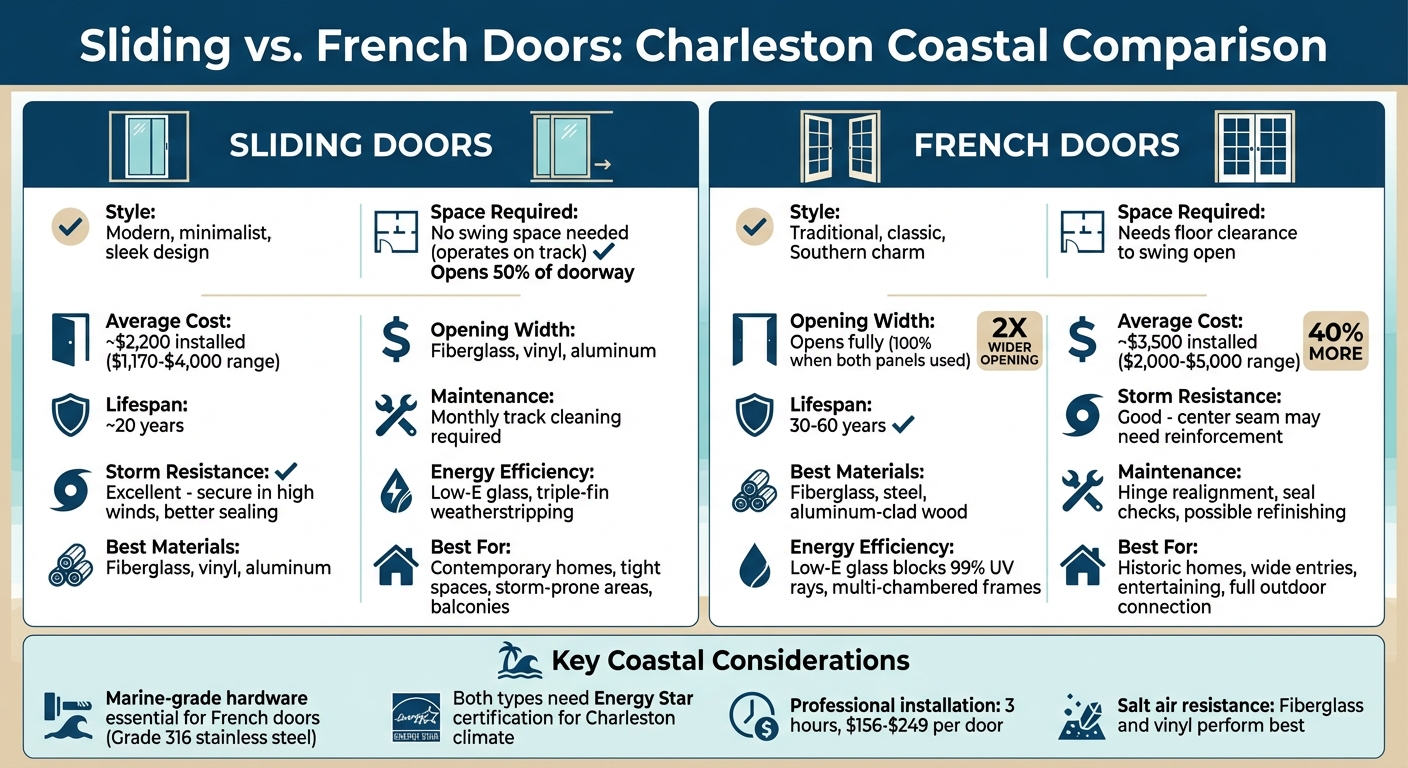
Sliding vs French Doors Comparison for Charleston Homes
Sliding Doors: Space-Saving Design and Contemporary Style
How Sliding Doors Work and Save Space
Sliding doors operate on tracks that run parallel to the wall, eliminating the need for the clearance required by traditional hinged doors. This makes them perfect for tight spaces, as you can place furniture right next to the door without any issues. Modern sliding doors can feature up to four panels, allowing for openings as wide as 16 feet. Some designs, like pocket doors, go a step further by letting the panels slide completely into the wall – an excellent solution for Charleston homes with limited space on patios, balconies, or in smaller rooms.
"Sliding doors move along a track as opposed to swinging open, optimizing space in areas where clearance for swinging doors is not feasible. Sliding doors typically feature large glass panels that act as a window wall, offering unobstructed views of the outdoors and allowing natural light to flood into the room."
– Vetrina Engineering and Martin Whitmore, President of US Window & Door
The large glass panels in sliding doors act as a "window wall", bringing in plenty of natural light. This feature can make smaller coastal rooms feel brighter and more open, while also providing stunning, uninterrupted views of the Lowcountry’s surroundings. With sleek, minimalist frames, sliding doors complement contemporary designs beautifully, all while using materials built to withstand coastal conditions.
Best Materials for Charleston‘s Coastal Climate
When it comes to Charleston’s humid and storm-prone environment, the right materials are critical for durability and performance.
- Fiberglass: Known for its strength, fiberglass stands up well to salt air, moisture, and rot. It’s a low-maintenance material that can even be textured to look like natural wood, offering the charm of wood without the upkeep.
- Vinyl: High-quality vinyl is another solid choice. It resists peeling and warping, even in extreme conditions, and requires very little maintenance – just an occasional wash to keep it looking good.
- Aluminum and Aluminum-Clad Wood: Aluminum is highly durable, especially against high winds and flying debris during hurricane season. Aluminum-clad wood combines a tough, moisture-resistant exterior with the warmth of real wood on the interior. Opt for impact-resistant glass and reinforced frames for extra protection during storms.
These materials are ideal for weathering Charleston’s coastal climate, ensuring that your sliding doors remain functional and attractive for years to come.
Energy Efficiency and Weather Protection
In addition to durability, modern sliding doors offer features designed to enhance energy efficiency and protect against the elements. For instance, Low-E (low-emissivity) glass coatings are a game-changer for Charleston’s hot summers, reflecting solar heat and reducing cooling costs. Fiberglass and vinyl frames, often equipped with thermal breaks, provide better insulation compared to standard aluminum frames.
High-quality sliding doors also include features like triple-fin weatherstripping and interlocking center rails to keep out air and water during storms. While their sealing method differs from that of French doors, well-installed sliding doors can deliver excellent energy performance.
"By installing sliding doors with impact glass and weather stripping, homeowners will stay comfortable year‑around without having to inflate their energy bills for heating and cooling."
– Patriot Windows & Doors
For the best results, look for sliding doors with the ENERGY STAR label and check the NFRC ratings. Aim for a lower Solar Heat Gain Coefficient (SHGC) to minimize heat gain from the sun. Multi-point locking systems not only improve security but also help the door withstand strong winds during storms. Routine maintenance, such as cleaning the tracks and lubricating the rollers, will ensure smooth operation and preserve the tight seal – essential in salty, coastal conditions.
sbb-itb-cdbcc3e
French Doors: Classic Style and Indoor-Outdoor Connection
Design Options and Visual Appeal
French doors bring an elegant touch to Charleston’s architectural styles, whether it’s the balanced look of Colonial designs, the intricate ironwork of Victorian homes, or the charm of Lowcountry cottages. Their hallmark double-door design opens from the center, creating a dramatic frame for outdoor views, whether it’s a garden, porch, or waterfront.
Contemporary styles now offer sleeker frames and larger glass panes, giving them a modern edge while keeping their timeless charm. These expansive glass panels flood interiors with natural light, especially in south-facing rooms that soak up the afternoon sun. Unlike sliding doors, French doors open fully, as both panels swing outward or inward, making the doorway significantly wider – sometimes twice as wide as a sliding door opening. This design enhances the connection between indoor and outdoor spaces, allowing fresh air to flow through your home, which is perfect for Charleston’s humid subtropical climate. It also creates a seamless transition to piazzas, patios, or gardens. Now, let’s look at how materials are tailored to handle the challenges of coastal living.
Materials That Withstand Coastal Conditions
French doors, due to their hinged design and visible hardware, require materials that can endure the harsh conditions of coastal environments.
For starters, marine-grade hardware is a must. Materials like Grade 316 stainless steel, solid brass, bronze, or pewter resist corrosion caused by salt air. Standard hardware simply doesn’t hold up in these settings and can deteriorate in just a few years. This makes upgrading to marine-grade options essential for the exposed hinges and locking mechanisms of French doors. For the door frames, steel and iron are excellent choices. They provide the strength needed for large glass panels while offering high-impact resistance without adding unnecessary bulk.
Energy Performance in Humid Climates
In Charleston’s warm, humid climate, modern French doors are designed to perform efficiently. Low-E glass coatings are a standout feature, blocking up to 99% of harmful UV rays while keeping interiors cooler. Double or triple-pane glass provides additional insulation, and multi-chambered frames help reduce heat transfer.
"With low-emissivity (low-E) glass and proper weatherstripping, modern French doors help keep your space well-lit without overheating, reducing the need for extra cooling."
– Icon Window & Door
One challenge with French doors lies in their sealing. Hinged doors, unlike sliding ones, have more seams where air can seep through – an issue that’s particularly relevant in storm-prone coastal areas. Multi-point locking systems address this by securing the door at multiple points along the frame, creating a tighter seal and adding extra security. Regular maintenance, such as checking weatherstripping, is crucial since exposure to sea salt can wear it down faster. With proper care and installation, French doors can last anywhere from 30 to 60 years, depending on the materials used. These features not only make French doors energy-efficient but also ensure they hold up well in humid, coastal settings.
How Each Door Type Handles Charleston’s Coastal Conditions
Dealing with Charleston’s coastal challenges requires doors built with durable materials and smart engineering. Knowing how different door types perform against salt exposure, storms, and maintenance demands can help homeowners make the right choice for long-term durability in this unique environment.
Resistance to Salt Air and Moisture
Charleston’s salty air can be relentless, slowly breaking down materials over time. Fiberglass doors are a top pick for coastal homes because they resist salt and moisture without absorbing them. This means no swelling, warping, or cracking, even in the humid Lowcountry climate. Vinyl doors also handle moisture well and come at a lower price point, though they may wear out faster under intense sun and wind.
"Salt air may look harmless, drifting in from the shoreline, but it works like sandpaper on anything it touches. Even the smallest gaps in a sliding patio door invite moisture."
– Martin Whitmore, President, US Window & Door
Aluminum frames can hold up well if they have a marine-grade coating, but untreated wood French doors are vulnerable to decay in coastal conditions. Aluminum-clad wood doors provide better protection, with an exterior shell that shields the wood core from moisture and pests. Sliding doors often perform better in keeping out air and water because they have fewer seams than French doors, which are more prone to leaks at hinges and the center seam.
| Material | Salt Resistance | Moisture Resistance | Maintenance Level |
|---|---|---|---|
| Fiberglass | Excellent | Excellent | Low |
| Vinyl | High | High | Low |
| Aluminum (Marine-grade) | High | Excellent | Moderate |
| Clad-Wood | Moderate (Exterior) | High (Exterior) | Moderate |
The material is just one piece of the puzzle. Structural design plays a big role in how these doors handle storms and harsh weather.
Storm Protection and Impact Resistance
When hurricane season rolls in, sliding doors tend to hold up better than French doors. Their interlocking panels and lack of hinges create a tight seal, making them less likely to fail under high winds or extreme pressure.
"Traditional double doors might be subject to air infiltration and more likely to be yanked open in a storm if the hinges are not reinforced."
– Patriot Windows & Doors
French doors, on the other hand, are more vulnerable. The center seam and hinges are weak points that can fail during storms unless reinforced or paired with hurricane shutters. Sliding doors designed for impact resistance often meet High-Velocity Hurricane Zone (HVHZ) standards, making them a solid choice for Atlantic coastal areas. While both door types can include laminated glass and multi-point locks to meet building codes, sliding doors usually require fewer upgrades to provide the same level of storm protection.
Even with strong materials and designs, regular sealing and maintenance are essential to combat the challenges of a coastal climate.
Water Sealing and Maintenance Requirements
Sliding doors need monthly track cleaning to clear out sand and salt that can wear down rollers. French doors require extra care for their hinges, which can loosen over time due to the weight of heavy glass panels. The center seam also needs frequent checks to maintain a weatherproof seal.
To prevent corrosion, wipe down door frames regularly to remove salt buildup, and rinse them with fresh water to wash away deposits. Inspect weatherstripping every few months for signs of damage or swelling caused by moisture. For French doors, tighten hinge screws periodically to stop sagging, which can weaken the seal at the threshold.
| Maintenance Task | Recommended Frequency | Coastal-Specific Notes |
|---|---|---|
| Track Cleaning | Monthly | Clear out abrasive sand and salt buildup |
| Roller Assessment | Quarterly | Check for rust, pitting, or worn bearings |
| Seal/Weatherstripping Review | Quarterly | Inspect for salt damage or moisture swelling |
| Frame Inspection | Twice Yearly | Look for early signs of corrosion or wood rot |
Regular care goes a long way in keeping doors functional and looking good, even in Charleston’s tough coastal conditions.
Sliding Doors vs. French Doors: Side-by-Side Comparison
Deciding between sliding and French doors means weighing aesthetics, practicality, and durability – especially in Charleston’s coastal climate. Here’s a breakdown to help you make an informed choice.
Appearance and Architectural Fit
Sliding doors bring a sleek, modern vibe with their slim frames, creating a seamless "window wall" look. On the other hand, French doors exude timeless elegance, featuring wider, decorative frames that perfectly complement Charleston’s traditional Southern architecture.
Space Efficiency
Sliding doors glide along a horizontal track, requiring zero swing space. This makes them ideal for tight spots like balconies or smaller rooms. French doors, however, need room to swing open. But if you open both panels, they provide the full width of the entryway, offering a grander feel.
Durability and Weather Performance
Sliding doors generally last around 20 years and perform well in high winds, staying securely closed during storms. French doors can last much longer – 30 to 60 years – with the right materials. Fiberglass or vinyl frames are excellent choices for coastal homes, as they resist salt corrosion far better than aluminum-clad frames, which may deteriorate within 10 to 12 years.
Cost Considerations
Sliding doors typically cost around $2,200 installed, while French doors average $3,500 – roughly 40% more. Overall, sliding doors fall within a range of $1,170 to $4,000, whereas French doors range from $2,000 to $5,000. The table below highlights these differences for easy comparison.
| Feature | Sliding Doors | French Doors |
|---|---|---|
| Style | Modern, minimalist, sleek design | Traditional, classic, Southern charm |
| Space Required | No swing space; operates on a track | Requires floor clearance to swing |
| Opening Width | Typically opens 50% of the doorway | Opens fully when both panels are used |
| Average Lifespan | Approximately 20 years | 30–60 years |
| Storm Resistance | Secure in high winds | Center seam may need reinforcement |
| Average Cost | ~$2,200 installed | ~$3,500 installed (about 40% higher) |
| Best For | Contemporary homes, tight spaces, coastal views | Historic homes and wide, open entries |
Installation, Maintenance, and Costs
Installation Process and Time Required
Choosing the right door isn’t just about looks or materials – it’s also about how it’s installed and maintained over time. Sliding doors are often easier to install due to their simple track system and fewer moving parts. However, proper installation still requires attention to detail, like ensuring the tracks are level and rollers are aligned. French doors, on the other hand, demand more precision. Their hinges need careful alignment, and the center seam where the two doors meet must create a tight seal to keep out air and water. This is especially important in Charleston, where coastal conditions can be harsh.
In Charleston, professional installation typically takes about three hours. Labor costs alone range from $81 to $149, while the total installation cost, including materials and equipment, usually falls between $156 and $249 per door. Given the area’s coastal weather challenges, professional installation is a must to ensure proper weatherproofing against salt air and storms.
Ongoing Care in Coastal Areas
Living in a coastal area like Charleston means regular upkeep for your doors is unavoidable. Sliding doors need monthly track cleaning and lubrication to keep them running smoothly, while French doors often require hinge realignment and seal checks. French doors, especially wooden ones, may also need repainting or resealing every few years to prevent warping or rot – an extra commitment in humid, coastal conditions. However, if you opt for fiberglass or vinyl French doors, you can largely avoid these issues.
For both door types, it’s smart to inspect the weatherstripping annually. Any gaps or wear should be addressed immediately to maintain the door’s durability and efficiency. Maintenance costs for French doors, such as hinge adjustments or seal replacements, typically range from $179 to $226.
Price Ranges and Long-Term Investment
Initial costs and long-term maintenance play a big role in door selection, especially in Charleston’s challenging coastal environment. Sliding doors are generally more affordable upfront. Basic vinyl or fiberglass sliding doors start at around $400 for the unit alone, with mid-range options costing between $1,500 and $4,000. When factoring in installation, standard vinyl sliding doors typically range from $800 to $2,200.
French doors, however, tend to be pricier due to their more intricate hardware and installation needs. Basic sets start at about $800, with installed costs ranging from $1,200 to $4,000 for vinyl or fiberglass models. For those in Charleston’s historic districts, custom French doors with architectural details can cost as much as $10,000.
Material choice is key to balancing cost and durability. Sliding doors often last around 20 years, while French doors, with proper care, can last 30 to 60 years. However, wood French doors may require ongoing refinishing, which can add to their long-term cost. Fiberglass and vinyl options for both types are far better suited to Charleston’s salty air, offering durability without heavy maintenance, even if they come with a higher upfront price tag.
Opting for Energy Star-certified doors can also help offset costs. These doors may save enough on utility bills to cover their additional cost within 5 to 15 years – especially important in Charleston, where long cooling seasons and high humidity can drive up energy use.
Choosing the Right Door for Your Charleston Home
Deciding between sliding and French doors for your Charleston home comes down to your priorities – space, style, or functionality. For compact spaces like small balconies or patios, sliding doors are a practical and cost-effective option. They also offer better storm protection, which is a crucial factor in Charleston’s coastal climate. These doors are ideal when you need a sleek, space-saving solution.
On the other hand, if you’re restoring a historic home or aiming for that classic Lowcountry charm, French doors are hard to beat. They provide a nearly full-width opening – for instance, a 6-foot French door allows access to almost the entire width, compared to the roughly 3 feet offered by a sliding door. This makes them perfect for entertaining or easily moving large items. However, they do require extra swing clearance, so make sure your space can accommodate this. For durability in Charleston’s humid, coastal environment, materials like fiberglass or steel are your best bet for French doors.
When it comes to frames, options like vinyl, fiberglass, or aluminum-clad materials are better suited to handle the challenges of coastal living. While wood frames are undeniably attractive, they require regular maintenance and refinishing, which might not be practical in this setting.
Budget is another key factor. Sliding doors are generally more affordable to install, while French doors often come with a higher upfront cost, especially if you’re opting for custom designs in historic neighborhoods. Regardless of the type, investing in Energy Star-certified doors can pay off in the long run by improving energy efficiency. Ultimately, the right choice will depend on your space, style, durability needs, and budget.
FAQs
Do I need impact-rated glass in Charleston?
In Charleston, using impact-rated glass is strongly advised. Not only does it help meet local building codes, but it also offers enhanced protection against hurricane-force winds and flying debris. This added layer of security is crucial in high-risk wind zones, helping to safeguard your home during severe storms.
Which door seals better in wind-driven rain?
Sliding doors are often more effective at keeping out wind-driven rain. This is because they have fewer seams and are equipped with more efficient weatherstripping. On the other hand, French doors use multi-point locking systems and weatherstripping, but they may not hold up as well under heavy rain or strong winds.
What door is easiest to maintain near the coast?
French doors tend to be a more practical choice for coastal areas because their design and corrosion-resistant hardware make them easier to maintain. When sealed correctly, they offer better protection against salt air and high humidity. On the other hand, sliding doors often require more maintenance since their tracks and rollers are more exposed to the damaging effects of salt and moisture commonly found near the coast.