
Want to save big on construction materials? Bulk ordering windows, doors, and hardware directly from manufacturers or wholesalers can cut costs by 30% or more compared to retail prices. This approach not only reduces expenses but also ensures consistent quality across projects. Here’s how you can maximize your savings:
- Standardize product packages: Use common sizes and materials to qualify for bulk discounts and streamline procurement.
- Build strong supplier relationships: Trade accounts can secure discounts of 5%-20% and better payment terms.
- Use takeoff software: Tools like Buildxact improve order accuracy and reduce waste.
- Negotiate volume pricing: Consolidate orders across projects to unlock higher discount tiers.
- Optimize delivery schedules: Match deliveries to project phases to avoid delays or damage.
- Choose cost-effective materials: Vinyl windows and fiberglass doors balance affordability and durability.
- Simplify hardware choices: Standardize specs to reduce errors and leverage bulk discounts.
Partnering with reliable suppliers like Icon Window & Door simplifies the process, offering custom solutions and scheduled deliveries. Start planning early to keep your projects on budget and on time.
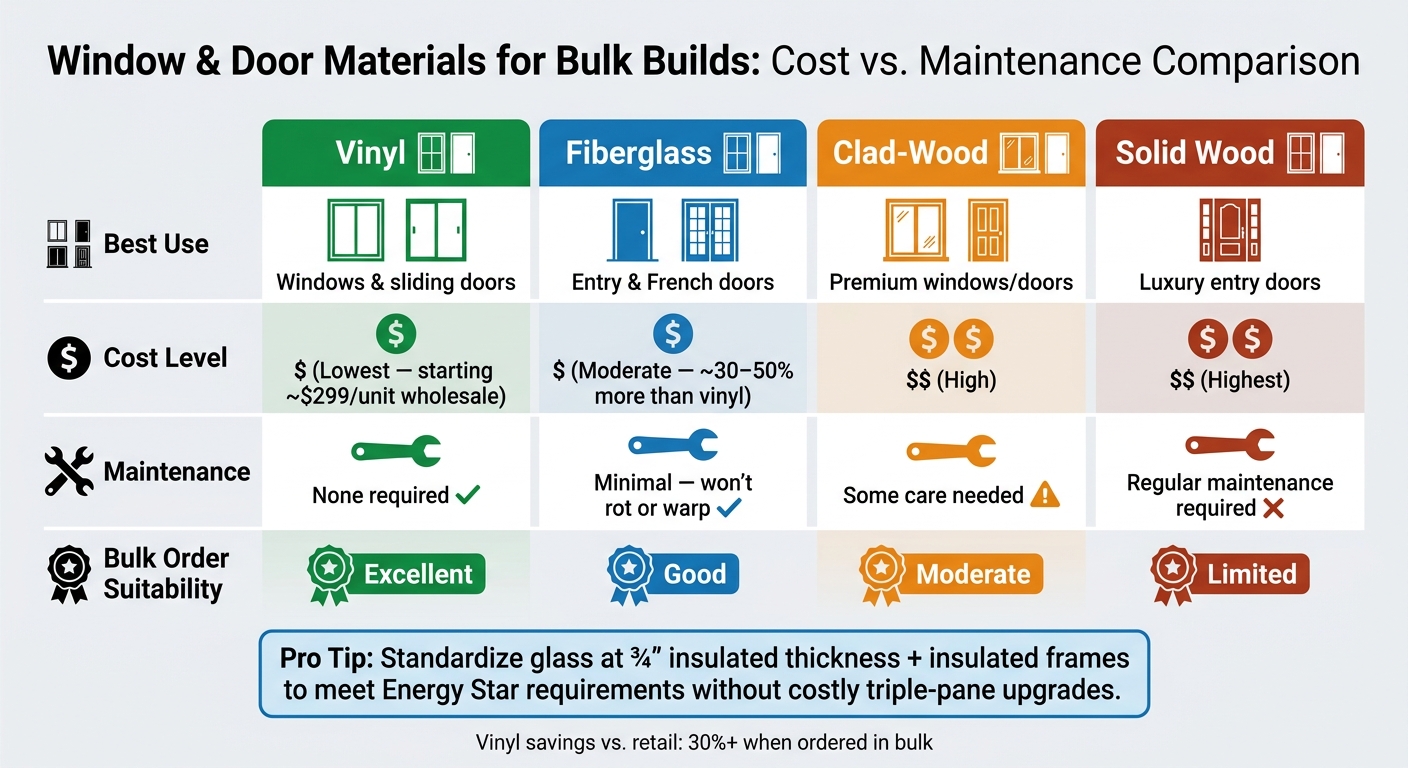
Window & Door Materials for Bulk Builds: Cost vs. Maintenance Comparison
1. Standardize Window and Door Packages
Choosing standardized window and door packages can help cut costs while maintaining consistent quality across projects. By sticking to standard sizes, materials, and configurations, you can qualify for bulk pricing – often 30% or more below retail rates. This approach simplifies procurement and ensures efficiency.
For example, standard dimensions like 36×80 inches for single doors or 60×80 inches for double doors are widely available as stock items. Using these common sizes means you can take advantage of bulk discounts, avoid long lead times, and keep your project timelines on track. Material and finish choices can also streamline the process, making bulk ordering even more efficient.
"Sourcing common dimensions… in bulk is one of the easiest ways to save time and money." – usabuildersdepot.com
Steel doors are a solid choice for multi-unit projects. They’re durable, fire-resistant, and require minimal maintenance. Opting for prehung units instead of slab doors can save time during installation and improve sealing performance.
Additionally, sticking to a single hardware finish – like Satin Nickel or Black – and using "Keyed Alike" locks simplifies both procurement and property management. By keeping specifications consistent from the start, you minimize errors, speed up ordering, and make it easier to qualify for bulk pricing tiers that can significantly reduce costs.
sbb-itb-cdbcc3e
2. Build Strong Supplier Relationships for Better Pricing
Once you’ve standardized your selections, the next step is strengthening your supplier relationships to cut costs even further. Strong partnerships with suppliers often lead to better pricing and smoother operations.
Formalize your supplier relationships for added benefits. Applying for a professional trade account can turn you from a one-off buyer into a valued repeat customer. This status often comes with perks like pre-negotiated pricing, dedicated support, and early access to new inventory. Debbie Trecek from Buildertrend highlights the importance of these connections:
"A good supplier relationship can mean the difference between a project that’s on time and on budget – and one that’s not."
Contractors typically enjoy discounts ranging from 5% to 20% off standard pricing. Many suppliers use tiered discount structures, such as 5% off for annual purchases under $50,000, 10% for $50,000–$100,000, and 15% for spending over $100,000. Paying invoices promptly – or even ahead of schedule – can shave an additional 1% to 3% off your costs.
Keep your supplier in the loop about upcoming projects. Sharing your project pipeline allows suppliers to plan ahead by reserving inventory, notifying you of potential price changes, and prioritizing your orders during peak times. This transparency builds trust and fosters open discussions about lead times and material availability.
Ask for an itemized cost breakdown in quotes. Breaking down quotes into categories like materials, freight, hardware, and finishes helps you see exactly where your money is going. This clarity makes it easier to identify areas for negotiation.
3. Use Takeoff Software to Get Accurate Quantities
Accurate takeoffs are a cornerstone of effective cost control in construction. Overordering ties up cash flow unnecessarily, while underordering can halt progress and lead to expensive rush deliveries. Takeoff software addresses both issues by replacing manual counting methods with precise, blueprint-driven calculations.
These AI-powered tools scan floor plans and elevations to automatically count every window, door, and storefront opening. They then cross-check these counts with project schedules to flag any discrepancies before you place bulk orders. For example, when calculating for a hardware assembly building, the software doesn’t just count a single door – it also adds every related component, like hinges, locks, handles, closers, and stops, to your materials list. This ensures nothing is overlooked, and you avoid inflating quantities unnecessarily.
The efficiency gains are significant. Glazing contractors using AI-driven takeoff tools report reducing estimation times by 50% or more, all while achieving 97%+ accuracy. Mike Phillips from Miller-Tippens Construction highlighted this benefit:
"You could spend a couple days doing an accurate takeoff that you can now do in a matter of hours using On-Screen Takeoff."
This precision strengthens your bulk-order strategy by grounding estimates in solid data. Once your counts are finalized, you can export the data as an itemized Excel or CSV file to request bulk pricing quotes. This approach ensures your bids are based on actual numbers, not rough estimates. Some platforms, like Buildxact, even integrate with dealer price lists, so your quantities reflect up-to-date market pricing automatically.
Getting started with these tools is cost-effective. ConstructConnect offers a free 14-day trial, ProTakeoff plans begin at $99 for projects under 2,500 sq. ft. (with $25 add-ons for specific trades), and Buildxact provides a 15% discount on annual subscriptions compared to monthly plans.
4. Negotiate Pricing Tiers and Payment Terms
When you commit to specific quantities, you gain a strong position for negotiating prices. Suppliers often base their pricing on volume tiers, and knowing your standing in these tiers gives you an edge. High-margin items like windows, doors, and cabinetry typically offer more room for negotiation. By consolidating orders across multiple projects, you can reach higher discount tiers. Another option? Team up with local contractors to form buying groups, pooling orders to unlock better rates.
"Volume is your greatest asset in any negotiation." – USABuildersDepot
Maximizing volume by combining orders across projects is a straightforward way to secure better pricing tiers.
When it comes to payment terms, aim for discounts tied to early payments. For instance, suppliers may offer 1% to 3% off the total invoice if you have a history of paying on time. For larger orders, negotiate a price hold valid for 90 to 120 days. This protects your bid price from market fluctuations while accounting for potential project delays. Typically, an agreed escalation rate of about 0.5% per month can be included to cover any extended timelines.
Another key tactic is to secure landed pricing (DDP). This approach bundles freight, insurance, and delivery costs into a single fixed amount, helping you avoid unexpected fees that could drive up your final costs.
"The best negotiation outcome is often not the biggest sticker cut, but the lowest true project cost after freight, accessories, waste, and time are included." – Marcus Ellison, Senior Deals Editor
These strategies work hand-in-hand with the standardized packages and supplier relationships discussed earlier, ensuring you keep costs predictable and manageable.
5. Schedule Deliveries to Cut Down on Waste
Once you’ve locked in pricing, the next challenge is timing your deliveries effectively. Materials that arrive too soon can clutter the site, risk exposure to the elements, or even be stolen. On the flip side, late deliveries can bring your project to an expensive standstill. Just like buying in bulk helps cut costs, syncing deliveries with your project timeline can stretch your budget even further.
"A delay in materials can bring the entire job to a halt, costing you time and money." – USA Builders Depot
The key here is timing. Schedule deliveries to match the phase of the project that requires them. For instance, windows and doors don’t need to be on-site during framing. Work with your supplier to ensure these items arrive only when the structure is ready for installation – not weeks in advance.
To save even more, consolidate your orders into fewer, larger shipments. This reduces both transportation costs and the likelihood of damage during handling. Before materials arrive, prepare a safe, sheltered storage area away from high-traffic zones to protect them from damage or loss. As USA Builder Depot explains, "Proper material storage prevents damage and loss, preserving your budget".
Lastly, partner with suppliers who provide clear communication about shipping. Tools like real-time tracking and confirmed delivery windows make it easier to schedule your crew efficiently. This way, you avoid workers standing idle or rushing to clear space for an unplanned delivery.
6. Pick Cost-Effective Materials for Windows and Doors
Once you’ve locked in pricing tiers and delivery schedules, selecting the right materials can make a big difference in keeping bulk order costs under control. Your choice of materials doesn’t just affect upfront costs – it also influences long-term expenses like maintenance and replacements. The right option can save you money over time, while the wrong one might quietly eat away at your budget.
Vinyl is a top choice for high-volume projects because it’s low-maintenance, energy-efficient, and available at wholesale prices starting around $299 per unit. If you go with vinyl, make sure to specify virgin vinyl (99% pure), as recycled vinyl tends to fade and warp more easily over time.
For entry and French doors, fiberglass strikes a good balance between style and durability. It offers the look of wood without the upkeep, resists rotting and warping, and performs well in tough weather conditions. While fiberglass costs about 30% to 50% more than vinyl upfront, its lower maintenance needs and longer lifespan can help offset that price difference.
If your project requires a traditional wood look, clad-wood is a reliable option. Some products, like those treated with AuraLast® technology, are designed to resist rot, water damage, and termites, making them much more practical than solid wood in various climates. However, clad-wood tends to be on the pricier side, so it’s best suited for premium units or highly visible areas rather than being used throughout an entire development.
Here’s a quick comparison of these materials for bulk residential builds:
| Material | Best Use | Cost Level | Maintenance |
|---|---|---|---|
| Vinyl | Windows, sliding doors | Lowest | None required |
| Fiberglass | Entry & French doors | Moderate | Minimal; won’t rot or warp |
| Clad-Wood | Premium windows/doors | High | Some care needed |
| Solid Wood | Luxury entry doors | Highest | Regular maintenance required |
To ensure performance and cost-efficiency, standardize glass thickness at ¾" insulated glass. Pairing this with insulated frames can help meet Energy Star requirements across different climate zones without the added expense of triple-pane glass – unless your project specifically calls for it.
Simplifying hardware choices is the next step to further streamline your bulk orders.
7. Keep Hardware Selections Simple for Bulk Orders
When managing bulk orders, it’s not just about windows and doors – you’ve got to think about hardware too. Whether you are ordering single hung windows or complex door systems, keeping hardware selections simple and consistent can save you a ton of headaches. Keeping hardware selections simple and consistent can save you a ton of headaches. A limited, standardized set of hardware options makes everything easier: from consolidating orders and negotiating prices to avoiding installation mistakes. For example, sticking to uniform specs like spindle diameters, backsets, and keeper offsets helps prevent on-site issues like hardware binding and reduces the chance of errors during installation.
From a financial perspective, fewer SKUs mean bigger savings. Instead of spreading your orders thin across multiple product lines, consolidating into one larger order gives you more leverage. Larger orders can unlock higher discount tiers and better terms. Plus, buying directly from wholesalers cuts out distributor markups, leaving room in your budget for premium finishes or upgrades. This strategy also ensures better long-term reliability for replacement parts.
Speaking of reliability, choosing hardware from suppliers with consistent, long-term availability is crucial. Imagine needing a replacement hinge or latch two years after installation, only to find out it’s been discontinued. To avoid this hassle, work with suppliers who offer clear part identification and a commitment to reproducing the same specs over time.
For projects in coastal or humid areas like South Carolina, stainless steel grades 304 or 316 are a smart choice. While they might cost slightly more upfront, they’re far more resistant to corrosion than cheaper finishes. This small investment can save you from the massive cost of replacing rusted hardware across multiple units.
"I would standardize critical geometries and finishes first, then widen sourcing only where substitution risk is genuinely manageable." – Fschier
8. Work with Icon Window & Door for Bulk Order Support
After considering the strategies for bulk ordering, partnering with a dependable supplier is key to unlocking those cost benefits. Pair these approaches with the expertise of Icon Window & Door to maximize savings in the South Carolina residential market.
Icon Window & Door, established in 2020 as a family-run business, has become a trusted resource for large-scale builders across South Carolina’s Lowcountry. They offer transparent quotes, custom sizing, and scheduled delivery, simplifying the process and eliminating uncertainty. Their product selection includes interior and exterior doors, windows, and hardware, ranging from budget-friendly to premium options. They also specialize in non-standard sizes and custom configurations that go beyond typical catalogs. One builder shared their experience:
"I called everyone on Google looking for 60″ windows. None were willing to look further than their catalog… Icon quickly found what I needed." – Randy H.
With an impressive 4.9/5 rating from Lowcountry builders, Icon Window & Door is built to handle bulk orders. To ensure your project runs smoothly, schedule a consultation early to discuss your requirements and receive an accurate, detailed quote.
Conclusion
Saving money on bulk orders starts with smart planning well before construction begins. Thinking ahead, choosing standardized options, and building strong supplier relationships early on are key strategies to keep projects both on budget and on schedule.
For example, builders who buy windows and doors at wholesale prices can save 30% or more compared to retail. These savings can significantly stretch your project budget, making a noticeable difference in overall costs.
Standardized dimensions add to these savings by speeding up installation, reducing measurement errors, and simplifying reorders – helping eliminate the hidden costs that can eat away at your margins over time.
Partnering with a supplier who understands bulk order requirements makes this process even smoother. Icon Window & Door offers a wide product selection, custom sizing options, and direct-to-site delivery – everything South Carolina builders need to keep large-scale projects running seamlessly.
FAQs
What’s the best way to estimate quantities before placing a bulk order?
To plan quantities for a bulk order, start by examining architectural plans or blueprints. Count the required units, note their sizes, and identify the hardware needed. Using digital tools – such as AI-powered takeoff software – can streamline this process by quickly measuring dimensions and calculating item counts directly from digital plans, helping to minimize mistakes. Once done, compile a detailed takeoff report that includes total quantities, sizes, and hardware specifications. This approach helps prevent over- or under-ordering, saving both time and money.
How many units do I need to order to qualify for true bulk pricing?
To access true bulk pricing, you’ll need to meet the supplier’s minimum order quantity (MOQ). The exact MOQ depends on both the product and the supplier, but it often means buying dozens – or even more – of the same item, like windows or doors. Be sure to contact your supplier directly to confirm their specific requirements.
How do I avoid damage, theft, or delays when bulk materials are delivered?
To avoid damage, theft, or delays with bulk deliveries, it’s crucial to confirm all shipping details ahead of time. Double-check delivery windows, maintain clear communication with suppliers, and review policies related to shipping costs and handling damaged goods. Additionally, plan storage and delivery timelines carefully to prevent overstocking or running into material shortages. Finally, ensure all materials meet local building codes by securing the necessary documentation – this step can save you from costly rework or unexpected delays.