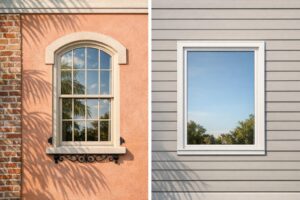
Choosing between custom and standard windows for your Charleston home depends on your budget, home style, and location. Here’s a quick breakdown:
- Custom windows: Tailored to fit specific openings, perfect for historic homes, and built to withstand coastal weather. They cost more ($500–$4,000+ per unit) but offer better durability (30–40 years), energy efficiency (up to 30% savings), and compliance with preservation rules.
- Standard windows: Affordable ($150–$750 per unit) and readily available, ideal for newer homes with standard-sized openings. However, they may not last as long (5–7 years in coastal areas) or meet historic district requirements.
Quick Comparison
| Feature | Standard Windows | Custom Windows |
|---|---|---|
| Cost | $150–$750 per unit | $500–$4,000+ per unit |
| Lifespan (Coastal) | 5–7 years | 30–40 years |
| Energy Savings | ~15% | Up to 30% |
| Lead Time | Days | 6–12 weeks |
| Fit Precision | 2-inch increments | Built to 1/8-inch accuracy |
| Historic Compliance | Rarely approved | Meets preservation rules |
| Storm Protection | Requires shutters | Impact-rated glass (DP-50+) |
Key takeaway: If you’re restoring a historic property or need windows that can handle Charleston’s coastal climate, custom is the way to go. For budget-friendly replacements in newer homes, standard windows work well.
Custom Windows: Built for Charleston Homes
What Custom Windows Offer
Custom windows are designed to fit your home perfectly, tailored in size, style, material, and performance. They come in a variety of designs, including double-hung, casement, and awning styles, and can be manufactured to nearly any size, with measurements accurate to within 1/8 inch of your opening. That level of precision is especially important for older Charleston homes, where settling over the years often results in irregular or non-standard window openings. These windows also offer a range of material options to balance aesthetics with performance.
Material choices include aluminum-clad wood, which combines a classic interior look with a tough exterior, as well as low-maintenance vinyl and fiberglass. For glass, options like Low‑E 366 coatings and triple‑pane glazing can help block UV rays and reduce cooling demands during Charleston’s humid, sweltering summers.
Benefits of Custom Windows
One of the standout benefits of custom windows is their exact fit. When windows are built to match your specific opening, they eliminate gaps and reduce the need for shims. This helps prevent air leaks, moisture intrusion, and even insect infestations.
In Charleston’s historic districts, custom windows can also meet the strict guidelines set by the Board of Architectural Review (BAR). This includes replicating 19th-century window profiles, such as three‑over‑six sash configurations, and ensuring the glass reflectivity matches the original design. Off-the-shelf windows rarely meet the BAR’s standards for visible facades.
"The tension for historic homeowners has always been this: how do you install windows engineered to withstand 170‑mph wind loads without destroying the three‑over‑six sash profile a Board of Architectural Review preservationist has spent a career protecting?" – Muhler
Durability in coastal conditions is another key advantage. Custom windows can be built to meet DP‑50 ratings, which means they can handle structural wind pressures of 170+ mph. This is a significant improvement over the DP‑35 rating of most standard windows, which caps out around 125 mph. Additionally, impact-resistant glass with SentryGlas Plus (SGP) interlayers – five times stiffer than standard PVB interlayers – helps keep the glass intact even when cracked, reducing structural risks during hurricanes. Homeowners in South Carolina who install fully impact-rated windows may also qualify for insurance discounts of up to 45%.
Tradeoffs of Custom Windows
Custom windows come with a higher price tag, costing approximately 25–50% more than standard options. Aluminum-clad wood windows, for example, range from $800 to $1,500 per unit, with installation adding another $100–$300 per window. Given these costs, precise measurements are critical to avoid expensive mistakes.
Another consideration is the lead time. Custom windows typically take 6 to 12 weeks to manufacture. If your home is in a historic district, the BAR review process can add another 30 to 60 days, potentially extending the entire window replacement project to 4 to 5 months from start to finish.
sbb-itb-cdbcc3e
Standard Windows: A Practical, Budget-Friendly Choice
What Standard Windows Offer
Standard windows are mass-produced in fixed sizes, usually in 2-inch increments (like 24", 26", or 28"), and are available in several popular styles. In Charleston, the go-to options include double-hung, single-hung, casement, and sliding windows. Most are crafted with PVC/vinyl frames. Thanks to mass production, these windows are readily available, often allowing for same-day installation.
Benefits of Standard Windows
The standout advantage of standard windows is their affordability. On average, standard vinyl windows are priced between $675 and $1,600 per unit, making them a cost-effective choice compared to custom-built alternatives. For homeowners working with tight budgets or facing urgent repairs – say, a broken window after a storm – the combination of lower costs and quick availability can be a lifesaver.
Even with their lower price point, standard windows come equipped with energy-saving features. Many include Low-E glass coatings, argon gas fills, multi-chamber frames, and warm-edge spacer technology – all designed to handle Charleston’s humid and hot climate. While they may not meet all historic preservation requirements, these windows are built to meet modern energy and durability standards, making them a solid choice for newer homes with uniform window openings.
Tradeoffs of Standard Windows
The fixed dimensions of standard windows can present challenges. If your window openings don’t align with these standard sizes – a common issue in older Charleston homes where walls may have shifted over time – you’ll need shimming or framing adjustments. As a general rule, if the opening varies by more than 1/4 inch, custom windows will provide a better, more secure fit.
For homes in Charleston’s historic districts, size mismatches are just part of the problem. The Board of Architectural Review (BAR) often rejects vinyl windows for historic buildings, requiring materials and designs that closely resemble the original architecture. Off-the-shelf vinyl windows typically don’t meet these standards.
Durability is another concern, especially in coastal regions. While standard windows might last over 20 years in inland areas, they may need replacing in as little as 5 to 7 years near the coast if they aren’t built to withstand salt air and high humidity. Additionally, without impact-rated glass, standard windows don’t offer much protection during severe storms. To meet Charleston’s Wind-Borne Debris Region requirements, you’d need to pair them with an approved shutter system.
"Standard windows that might last 20+ years inland often need replacement in as little as 5–7 years in coastal environments without proper protection." – Head of Installation, Muhler
Standard windows are a great fit for modern homes and rental properties but may not be the right solution for older or historic structures with irregular openings or BAR restrictions. These limitations highlight the key differences between standard and custom windows, setting the stage for a closer comparison.
Custom vs. Standard Windows: Side-by-Side Comparison
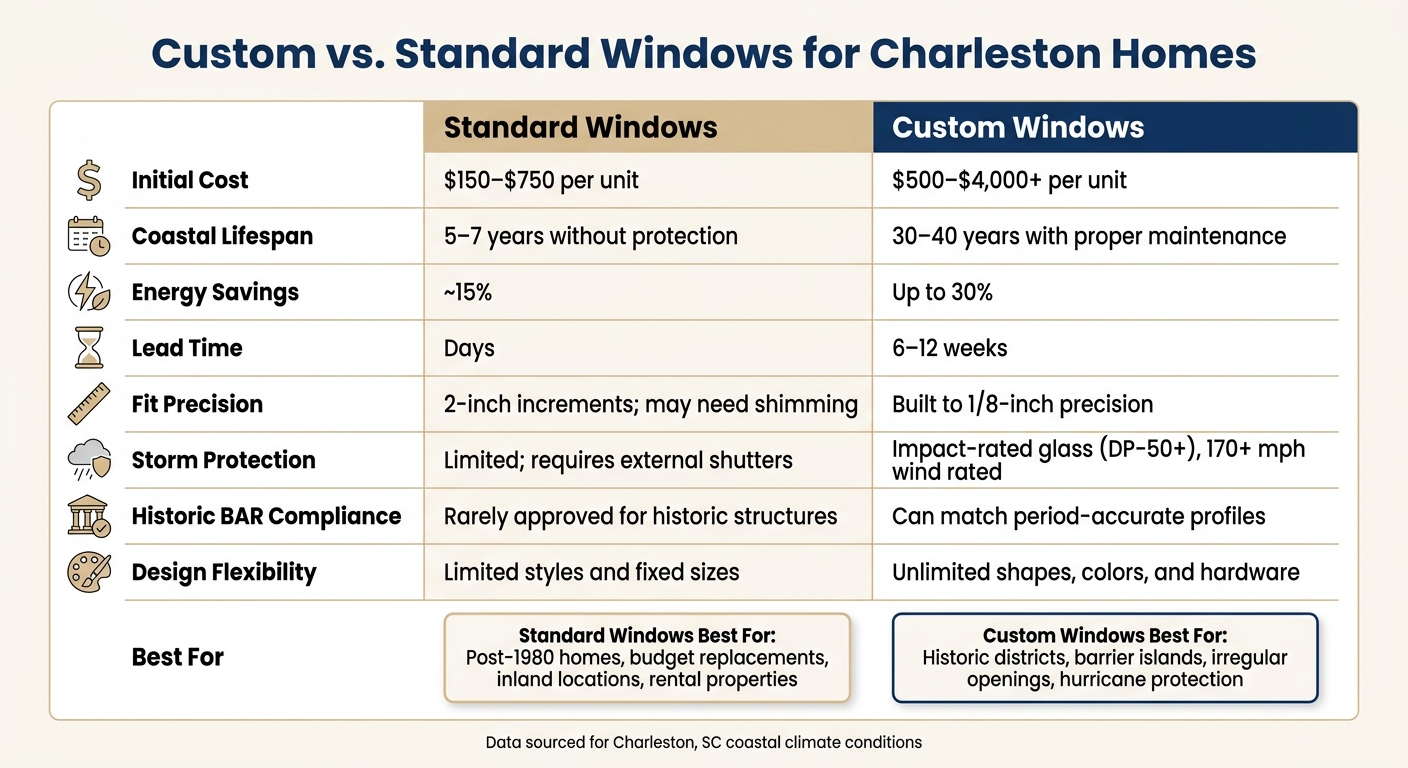
Custom vs. Standard Windows: Charleston Home Comparison Guide
Key Comparison Factors
When deciding between custom and standard windows, Charleston homeowners should weigh six important factors: cost, design flexibility, energy efficiency, storm durability, installation complexity, and long-term value.
Standard windows are more affordable upfront, making them appealing for homeowners on a tight budget. However, custom windows, which can cost 25%–50% more, offer significant benefits. Their triple-pane glazing and specialized Low-E coatings can cut energy bills by up to 30%. Plus, they’re built to last 30–40 years, compared to just 5–7 years for standard windows in coastal settings without added protection.
When it comes to design flexibility, custom windows stand out. Standard windows are limited to fixed 2-inch size increments and a small selection of styles. In contrast, custom windows can be crafted in virtually any shape – arches, trapezoids, or even floor-to-ceiling panels – making them ideal for unique architectural needs. They can also replicate historic sash profiles and true-divided-lite (TDL) configurations, meeting the strict requirements of Charleston’s Board of Architectural Review.
Storm durability is another critical factor in Charleston’s coastal environment. Custom windows can include impact-resistant glass rated at DP-50 or higher, capable of withstanding wind speeds over 170 mph. This eliminates the need for external shutters, unlike standard windows, which may not offer comparable protection.
"Standard windows often fall short in providing long-term performance in this coastal climate. Custom windows, on the other hand, are designed specifically for your home’s needs and the region’s challenges." – Muhler
The tables below provide a detailed comparison of these key factors.
Comparison Tables
| Factor | Standard Windows | Custom Windows |
|---|---|---|
| Initial Cost | $150–$750 per unit | $500–$4,000+ per unit |
| Lead Time | Days | 6–12 weeks |
| Fit Precision | 2-inch increments; may need shimming | Built to 1/8-inch precision |
| Energy Savings | ~15% | Up to 30% |
| Storm Protection | Limited; requires shutters | Integrated impact-rated glass (DP-50+) |
| Design Options | Limited styles and finishes | Unlimited shapes, colors, and hardware |
| Lifespan (Coastal) | 5–7 years without protection | 30–40 years with proper maintenance |
| BAR Compliance | Rarely approved for historic structures | Can match period-accurate profiles |
| Scenario | Better Choice | Why |
|---|---|---|
| Historic restoration | Custom | Meets BAR requirements for profiles and materials |
| Budget replacement | Standard | Lower cost for uniform openings in post-1980s homes |
| Beachfront or barrier island | Custom | Impact-rated glass and marine-grade hardware for salt air |
| Modern addition or unique shape | Custom | Accommodates non-rectangular openings and large glass panels |
| Standard suburban home (inland) | Standard | Uniform rough openings keep costs and timelines low |
How to Choose the Right Windows for Your Charleston Home
A Simple Decision Framework
When picking windows for your Charleston home, focus on four key factors: budget, home age and style, coastal proximity, and project timeline.
For homes built after 1980 with standard-sized window openings, standard windows are often an affordable and practical choice. However, if your home is in a historic district, located on a barrier island, or has window openings that vary more than 1/4 inch in width or height, custom windows are the better option. They provide a more precise fit, improved energy efficiency, and greater durability to handle Charleston’s coastal climate.
Timing matters. Custom windows, especially those requiring Board of Architectural Review (BAR) approval, can take anywhere from 3 to 6 months to complete. If you’re aiming to finish before hurricane season, it’s smart to begin the process by January.
Before making your selection, inspect your window openings for any signs of rot or air leaks. In older homes, foundation shifts can impact both your budget and timeline.
How Icon Window & Door Can Help
The decision-making process becomes much easier with expert advice. Since 2020, Icon Window & Door has been serving Charleston and the Lowcountry, including historic areas like Beaufort and Kiawah Island. Their leadership team brings over five decades of combined experience in construction and project management.
Icon Window & Door offers on-site consultations tailored to your home’s needs. Whether it’s checking rough openings for full-frame replacements, selecting the right glass for coastal conditions, or sourcing wood and clad-wood sashes that meet BAR requirements, they’ve got you covered. Their inventory includes both standard and custom window options in materials like vinyl, wood, clad, and steel – ensuring the focus remains on your home’s needs rather than a one-size-fits-all catalog.
"The right products should complement your home’s style while standing up to heat, humidity, storms, and salt air." – Icon Window & Door
FAQs
How do I know if my window openings require custom sizes?
When measuring rough openings for windows, take horizontal and vertical measurements at three different points. If these measurements don’t align with standard sizes (typically in 2-inch increments) or differ by more than 1/4 inch, you might need custom windows. Custom sizing works well for homes with shifted or uneven openings or older homes with unusual dimensions. Icon Window & Door can evaluate your openings and assist in turning your custom design into reality.
Are impact-rated windows worth it in Charleston’s coastal climate?
Absolutely, impact-rated windows make a lot of sense for Charleston’s coastal climate. In areas prone to wind-borne debris, these windows are often mandated by building codes to safeguard homes against strong winds and flying debris. But their advantages go beyond just meeting regulations.
These windows also enhance home security, help with noise reduction, and may even lead to lower homeowners insurance premiums. While the initial cost is higher, their long-lasting durability means you can skip the hassle of putting up storm shutters or plywood every hurricane season. Over time, they can save you effort and provide peace of mind.
What should I plan for in the timeline if BAR approval is needed?
If your project needs approval from the Board of Architectural Review (BAR), plan for an additional 30–60 days for the review process. The BAR-Small board meets roughly every two weeks to review exterior changes in historic districts. Make sure your submission is detailed and thorough – BAR requires replacement windows to closely match the originals in terms of material, profile, muntin configuration, and glass reflectivity to comply with preservation standards.