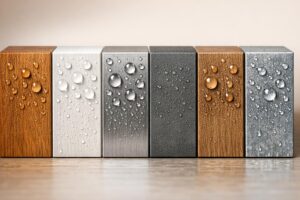
When it comes to preventing water damage in your home, the material you choose for window and door frames matters a lot. Each material – wood, vinyl, aluminum, fiberglass, composite, and steel – has strengths and weaknesses when dealing with water, especially in humid or rainy climates like South Carolina. Here’s what you need to know:
- Wood: Prone to swelling, shrinking, and rot without constant maintenance. Needs resealing or repainting every 2–5 years.
- Vinyl: Naturally resists water but can expand and contract with temperature changes. Low maintenance.
- Aluminum: Durable and non-absorbent but prone to condensation and corrosion, especially in coastal areas.
- Fiberglass: Stable, strong, and water-resistant, making it ideal for large openings and extreme climates.
- Composite: Combines the look of wood with better water resistance and durability.
- Steel: Strong but requires protective coatings to prevent rust.
Proper installation, including drainage systems and seals, is just as important as the material itself. Regular maintenance, like clearing weep holes and inspecting seals, can prevent costly repairs. For South Carolina homes, vinyl and fiberglass are often the best choices due to their resistance to moisture and minimal upkeep needs.
Quick Tip: Always pair your frames with marine-grade stainless steel fasteners in coastal areas to avoid corrosion. Regular inspections, especially after storms, can catch small issues before they escalate.
Understanding Water Penetration and Its Effects
The longevity of your frame material plays a big role in how quickly water intrusion becomes a problem.
What Is Water Penetration?
Water penetration refers to liquid water entering a building’s structure, typically due to gravity. It occurs when rainwater or runoff seeps through gaps or flaws in the building’s exterior. Proper water management in framed homes depends on three key elements: cladding, drainage, and a water-resistive barrier. If any of these layers fail, water can easily infiltrate. This highlights why even small installation mistakes can lead to major leaks.
Common Causes of Water Intrusion Around Frames
The most vulnerable point isn’t usually the frame material itself – it’s the connection between the frame and the surrounding wall.
Here are some common issues that lead to leaks around frames:
- Incorrect shingle overlap: Building paper or housewrap must be layered in a way that directs water downward and outward. If installed incorrectly, it can create "reverse flashing", which sends water into the wall instead of out. Poor detailing in this area is one of the main reasons for water intrusion in homes.
- Blocked drainage and debris: For flanged windows, taping the sill flange can block the exit for water that gets behind the frame, forcing it into the wall assembly. In brick or stone veneer walls, mortar droppings can clog the drainage cavity at the base of the wall, trapping water against the housewrap or frame. These examples show how crucial precision is during installation.
Signs of Water Penetration to Watch For
Spotting these issues early can help homeowners address water intrusion before it causes severe damage. Water damage often takes time to become noticeable. Forensic engineer Geoffrey Jillson notes that deterioration in sheathing and framing may start showing by the third year after construction, with severe damage becoming evident by the fifth or sixth year. Early detection is essential.
Here are some warning signs to look for around windows and doors:
- Stains or discoloration on interior walls or ceilings near frames
- Peeling or bubbling paint
- Musty odors in rooms with exterior-facing walls
- Warped or swollen frame edges
- Mold growth along the interior perimeter
On the outside, check for cracked or missing caulk, rust streaks below metal frames, and soft or spongy wood trim.
Regular inspections – especially after heavy rain or storms – can help identify small problems before they turn into expensive repairs. Pay special attention to the bottom corners of window frames and the threshold area of exterior doors, as water tends to collect in these spots first.
sbb-itb-cdbcc3e
How Different Frame Materials React to Water
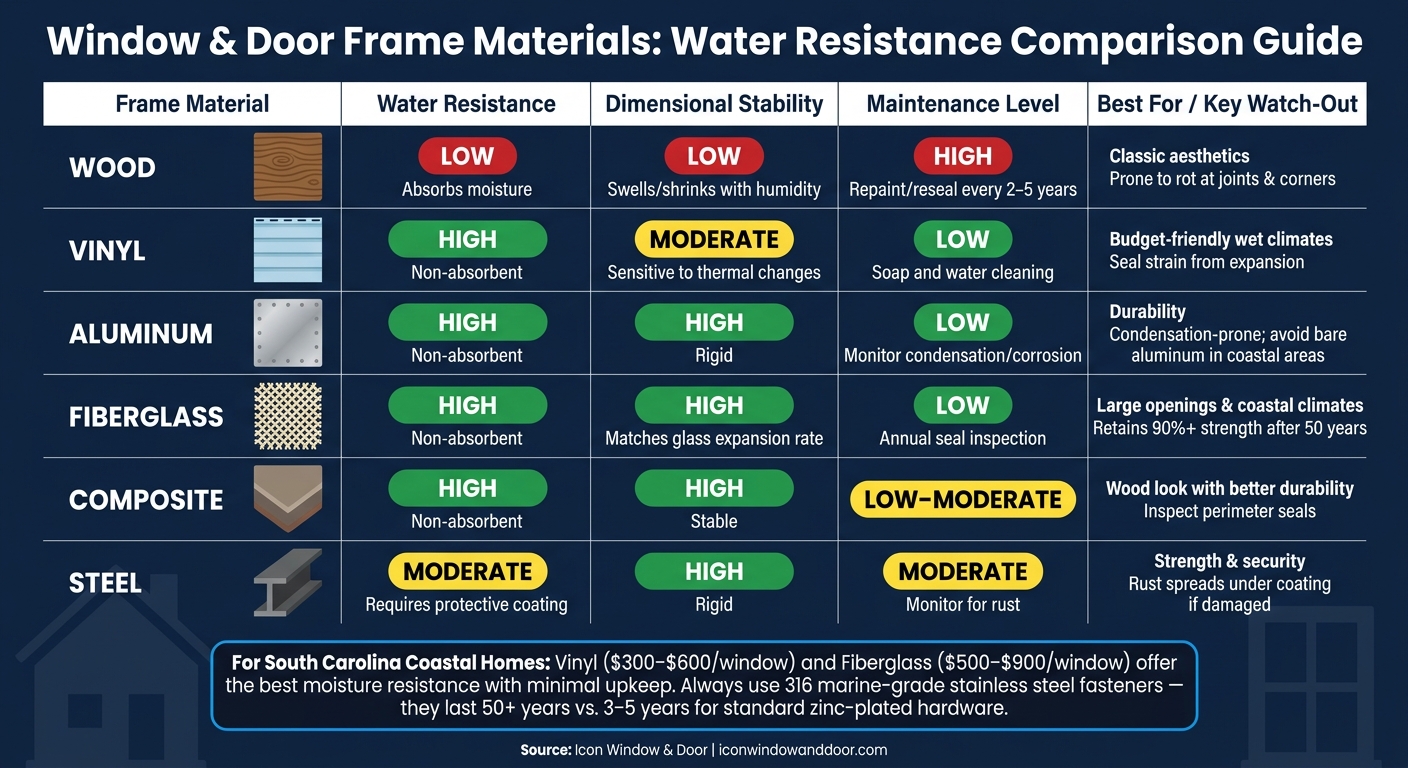
Window & Door Frame Materials: Water Resistance Comparison Guide
Different frame materials respond to moisture in unique ways, and these reactions can become especially noticeable in humid or rainy climates. Here’s a closer look at how various frame types handle water exposure.
Wood Frames: Beautiful but High-Maintenance
Wood frames require consistent care to combat their natural tendency to absorb moisture. As Steven Bliss explains:
"Wood… if well maintained, can endure for decades."
Without regular upkeep, wood can swell, cause sticking frames, and eventually rot – particularly at joints and corners. To prevent this, factory-treated wood with water-repellent preservatives is a better option than untreated lumber. Homeowners should plan to reseal or repaint wood frames every 2–5 years to keep them protected. Finger-jointed wood, in particular, needs extra vigilance, as any failure in the protective seal can quickly lead to deterioration.
Vinyl Frames: Naturally Moisture-Resistant
Vinyl frames are inherently resistant to water, making them a practical choice for wet climates. Features like fusion-welded corners and multi-chambered profiles further enhance their ability to keep moisture out. It’s no surprise that solid vinyl windows make up about 60% of the replacement window market.
However, vinyl isn’t without its flaws. It expands and contracts significantly with temperature changes, which can strain seals if the frames aren’t properly reinforced.
Aluminum Frames: Strong but Condensation-Prone
Aluminum frames are durable, non-absorbent, and maintain their shape well. They are often used as an exterior cladding for wood frames, providing a weather-resistant barrier while preserving the wood’s aesthetic appeal.
That said, aluminum conducts heat efficiently, making it prone to interior condensation in humid or cold conditions. This can lead to damage to drywall and trim. Frames with a thermal break – an insulating barrier within the aluminum profile – can reduce heat transfer by up to 500%. For coastal areas, 6063 T6 aluminum with AAMA 2605 finishes offers excellent resistance to salt-related corrosion.
Fiberglass and Composite Frames: Durable and Dependable
Fiberglass frames stand out for their dimensional stability and resistance to water. Their thermal expansion rate closely matches that of glass, ensuring seals remain intact even during extreme temperature swings. Fiberglass is also 8–10 times stronger than vinyl, making it ideal for larger window openings.
Composite frames, such as Fibrex (a blend of wood and vinyl), offer similar water resistance while mimicking wood’s appearance. Unlike traditional wood, composites resist rot. Tests show that fiberglass and composite frames retain over 90% of their strength after 50 years of exposure to moisture and UV light.
Steel Frames: Strong but Needs Protection
Steel frames are known for their rigidity, but they require high-quality corrosion-resistant coatings to fend off rust. Building codes mandate that steel used as weather covering must meet thickness standards, with a minimum of 0.0149 inches for corrosion-resistant steel. However, the coating’s quality is equally important, especially in humid or coastal environments. Once rust sets in, it can spread beneath the coating, compromising the frame’s structure.
| Material | Water Resistance | Dimensional Stability | Maintenance Level |
|---|---|---|---|
| Wood | Low (absorbs moisture) | Low (swells/shrinks with humidity) | High (repaint/reseal every 2–5 years) |
| Vinyl | High (non-absorbent) | Moderate (sensitive to thermal changes) | Low (clean with soap and water) |
| Aluminum | High (non-absorbent) | High (rigid) | Low (monitor for condensation/corrosion) |
| Fiberglass | High (non-absorbent) | High (closely matches glass expansion) | Low (clean with soap and water) |
| Composite | High (non-absorbent) | High (stable) | Low to moderate |
| Steel | Moderate (requires coating) | High (rigid) | Moderate (monitor for rust) |
Choosing the right frame material can make all the difference in preventing water-related issues, especially in challenging climates.
Installation and Testing for Water Resistance
Even the most water-resistant frame won’t do its job if it’s installed incorrectly. The way the frame connects to the wall is absolutely critical.
Why Installation Details Matter
The best method for keeping water out is called a two-stage seal, also known as a drained joint. Building scientist Christine Williamson breaks it down:
"To understand how windows manage water is really to understand the concept of the two-stage seal."
This system works by having two layers of defense. The inner seal creates an airtight barrier, while the outer seal deflects most of the water. However, the outer seal isn’t completely sealed – it allows any water that gets through to drain out instead of being trapped inside the wall. Taping or caulking the sill flange is a big no-no; it can trap water, leading to rot and mold.
Another key piece is the pan flashing at the sill. This needs a back dam – a small raised edge on the interior side – to stop water from flowing inward. It also has to slope outward so gravity can do its job and direct water away.
The materials used in window frames also play a big role in how they should be installed.
How Frame Material Properties Affect Installation
The characteristics of the frame material – its stiffness and how it reacts to temperature changes – directly impact installation techniques. For example, rigid materials like fiberglass and aluminum maintain their shape well, making it easier for sealants to stay watertight. On the other hand, flexible materials like vinyl require sealants that can stretch and contract with temperature shifts.
Shimming is another critical step. Shims ensure the frame is level and allow for proper drainage. Without them, the frame might press too tightly against the structure, compressing the sealant and blocking water from draining.
For flanged windows, often used with vinyl and aluminum, the head and jamb flanges are taped, but the sill flange is left open to allow drainage. Unflanged windows, commonly found in wood units, rely on backer rods and sealants applied to both the interior and exterior seals.
Understanding these material-specific requirements is essential for evaluating water resistance ratings.
How to Check Water Penetration Resistance Ratings
Window and door performance is measured through lab and field tests. ASTM E331 is a lab test that evaluates the window or door unit under controlled conditions. However, it doesn’t account for how the unit performs once installed in a wall. The installer is responsible for ensuring the window-to-wall interface is watertight. For on-site evaluation, ASTM E1105 is used. This test assesses water penetration resistance by spraying water on the exterior while simulating wind pressure.
The standard highlights the value of field testing:
"The major advantage of testing when assemblies are initially installed is that errors in fabrication or installation can be readily discovered and corrections made before the entire wall… is completed."
This test should be done after installation but before drywall goes up, making it easier to fix any issues. Keep in mind, test results are only valid if wind pressures stay within ±10%.
| Feature | ASTM E331 (Lab Test) | ASTM E1105 (Field Test) |
|---|---|---|
| What’s tested | The window or door unit itself | The installed assembly, including the wall interface |
| Environment | Controlled lab conditions | Actual building site |
| Purpose | Establish a baseline product rating | Verify installation quality or troubleshoot leaks |
For homeowners in coastal South Carolina, ensuring your installation meets these standards is key to long-lasting performance. Local experts like Icon Window & Door can provide guidance to ensure everything is done right.
Choosing the Right Frame Material for Your Climate
Climate, Rainfall, and Humidity: What to Consider
When selecting frame materials, your local climate plays a role just as important as your budget. In areas with high humidity, like coastal South Carolina, moisture can be a constant challenge. With average humidity levels ranging from 75–85% throughout the year, this environment encourages mold, mildew, and wood rot to thrive. Coastal UV exposure is also 15–20% higher than inland areas, which speeds up the deterioration of finishes.
Salt air adds another layer of complexity. It corrodes metal 5 to 10 times faster than in inland regions. A frame that performs well in other environments might degrade much faster in coastal areas. For instance, standard zinc-plated fasteners can lose 30–50% of their holding capacity within just five years in salty air, creating potential structural issues. These factors make it critical to assess how well a frame material will hold up over the long term in such challenging conditions.
Balancing Cost, Durability, and Maintenance
Beyond moisture resistance, it’s essential to consider the long-term costs and maintenance needs of different materials. While upfront costs are easy to see, the hidden expenses over time can add up. As Larson & George Baldwin of Baldwin Builders explain:
"The cheapest option upfront is almost never the cheapest option over 10 or 20 years. A $4,000 savings on siding that requires replacement in 8 years instead of 30 is not a savings – it is a liability."
The same principle applies to window and door frames. Vinyl frames, priced between $300–$600 per window (installed), are highly resistant to moisture and corrosion and require little maintenance. Fiberglass frames, which cost $500–$900 per window (installed), provide excellent structural strength and dimensional stability, making them a solid choice for larger openings. Aluminum-clad wood frames, costing $600–$1,200 per window (installed), combine the aesthetic appeal of wood with added protection, though they demand more upkeep in salty air environments. Understanding these trade-offs can help you make a more informed decision about materials that will stand the test of time.
Frame Material Recommendations for South Carolina Homes
To protect your home from water damage, selecting the right frame material is crucial. For homes in South Carolina, vinyl and fiberglass stand out as the best options for moisture resistance. Both materials are highly resistant to rot and corrosion and can endure the state’s intense summer heat. Vinyl offers a cost-effective solution for standard residential windows, while fiberglass is better suited for larger openings, upscale designs, or homes with direct coastal exposure due to its superior dimensional stability.
"Windows that perform well in northern states often fail to meet the specific demands of South Carolina’s southern coastal environment." – Your Exterior Pros
Bare aluminum frames, on the other hand, are best avoided in coastal areas. They are prone to rapid pitting from salt air and offer poor thermal performance. If you prefer the look of wood, aluminum-clad wood with a high-quality anodized or powder-coated finish can be a reasonable compromise, provided the exterior coating is well-maintained. Regardless of the material you choose, always pair it with 316 stainless steel (marine-grade) fasteners, which can last over 50 years – far outlasting standard zinc-plated hardware, which deteriorates in just 3–5 years.
For personalized advice, the team at Icon Window & Door specializes in helping South Carolina homeowners select the ideal frame material based on their home’s location, exposure, and design needs.
How to Maintain Frames and Prevent Water Damage
Seasonal Inspection and Cleaning
Proper installation is just the start – ongoing maintenance is key to keeping water damage at bay. Each spring and fall, take time to inspect the joints where frames meet the wall. This window-to-wall connection is a common trouble spot for water intrusion.
During your inspection, make sure the weep holes on your frames remain unobstructed. These small openings, sometimes hidden behind cladding, are designed to allow water to drain away from the frame. As Christine Williamson from Building Science Fight Club explains:
"You’d be a fool to seal up the weeps in your cladding system because you were worried about rain getting in. Eliminating drainage would very obviously make a wall perform worse, not better."
Additionally, examine the interior perimeter sealant for any gaps or cracks. This seal is crucial for keeping moisture-filled air out of your wall cavity. Once your inspection is complete, adjust your maintenance routine based on the specific material of your frame.
Maintenance Tips by Frame Material
Each frame material requires its own care routine to help prevent water damage. Here’s a quick guide:
| Frame Material | Maintenance Tasks | Main Vulnerability |
|---|---|---|
| Wood | Repaint or restain regularly; seal all finger joints | Prone to decay, rot, and joint separation |
| Vinyl | Check heat-welded corners; keep weep holes clear | Risk of corner seal failure and blocked drainage |
| Aluminum | Maintain protective finishes | Susceptible to condensation and corrosion, especially in coastal areas |
| Fiberglass | Inspect perimeter seals annually | Seals may degrade over time despite the material’s stability |
| Clad-Wood | Maintain interior wood; inspect exterior cladding seals | Vulnerable if moisture breaches the cladding and reaches the wood core |
For wood frames, it’s a good idea to prime all sides and apply a water-repellent preservative for added protection. On horizontal surfaces like sills, ensure there’s a slight slope – 3 to 5 degrees – so water flows away from the wall instead of pooling against it.
Spotting Leaks Early and Knowing When to Call a Pro
Staying ahead of leaks is essential. Look for early warning signs like stains on drywall, bubbling paint, or damp sills. If you suspect a leak but can’t identify its source, try the hose test: have someone spray water along the upper exterior edge of the frame while you monitor the interior for moisture. A pin-type moisture meter can also help detect hidden wet spots before they become visible.
If leaks persist or you notice soft spots, it’s time to bring in a professional. As Mad City Windows advises:
"If you’re breaking out the caulk gun every few months… a replacement window is the smarter move."
Keep in mind, most cases of window and door trim rot stem from missing or faulty flashing and exposed end grain – problems that sealant alone can’t fix.
Conclusion: Picking the Right Frame Material for Lasting Water Protection
No frame material is without its trade-offs. Wood offers a classic, timeless look but demands consistent maintenance. Vinyl and fiberglass, on the other hand, are excellent at handling moisture, making them ideal for humid areas like South Carolina. Aluminum stands out for its durability but may need extra care in coastal environments. Choosing the right material comes down to weighing your local climate, budget, and how much maintenance you’re willing to handle.
That said, even the highest-quality material won’t perform well without proper installation. Building scientist Christine Williamson explains:
"The beauty of the two-stage approach is that we’ve designed a system that isn’t dependent on perfection."
This means ensuring correct installation practices – like proper drainage, continuous interior seals, and protecting the rough opening – can make all the difference in achieving long-lasting water resistance.
Finally, regular upkeep is just as critical. Seasonal inspections can help you spot issues like failing seals or clogged weep holes before they turn into expensive problems. If you’re looking for professional advice on choosing the best frame for your home, reach out to Icon Window & Door. They specialize in residential windows and doors in South Carolina and offer a one-year workmanship warranty for added peace of mind.
FAQs
What’s the most common cause of leaks around windows and doors?
Leaks around windows and doors often happen at transition points in the exterior structure. These are the spots where different materials meet – like the perimeters of windows and doors. Over time, problems like deteriorating sealant or poor sealing can lead to water getting through. Regular maintenance and proper sealing are key to keeping water out.
Do I need field water testing after my windows are installed?
Conducting field water testing after installing windows is a smart move to check for water resistance and spot any potential leaks. This step becomes even more critical in areas prone to heavy exposure, where factors like installation quality and proper sealing play a huge role in ensuring the windows perform as expected.
Which frame material lasts longest in coastal South Carolina?
Fiberglass frames stand out as the most durable choice for coastal South Carolina. Thanks to their impressive structural strength and minimal thermal expansion, they hold up exceptionally well against salt air and the region’s tough environmental conditions, delivering reliable, long-term performance.