Replacing a door in Charleston, SC, comes with unique challenges due to the region’s coastal climate. High humidity, salt air, and intense heat can shorten the lifespan of doors, making material choice and proper installation critical. Here’s what you need to know:
- Climate Impact: Doors in Charleston may need replacement every 5–7 years due to salt air, corrosion, and humidity.
- Best Materials: Fiberglass and steel doors with insulated cores and weatherproof seals perform well in these conditions.
- Energy Savings: Upgrading can reduce energy bills by 15–25%, saving $250–$400 annually.
- Security Features: Multi-point locks, reinforced frames, and corrosion-resistant hardware offer better protection.
- Professional Installation: Precise measurements and proper sealing are essential for long-lasting performance.
Choosing the right door and hiring skilled installers ensures durability, energy efficiency, and security for your home in Charleston’s tough environment.
Selecting the Right Door for Your Charleston Home
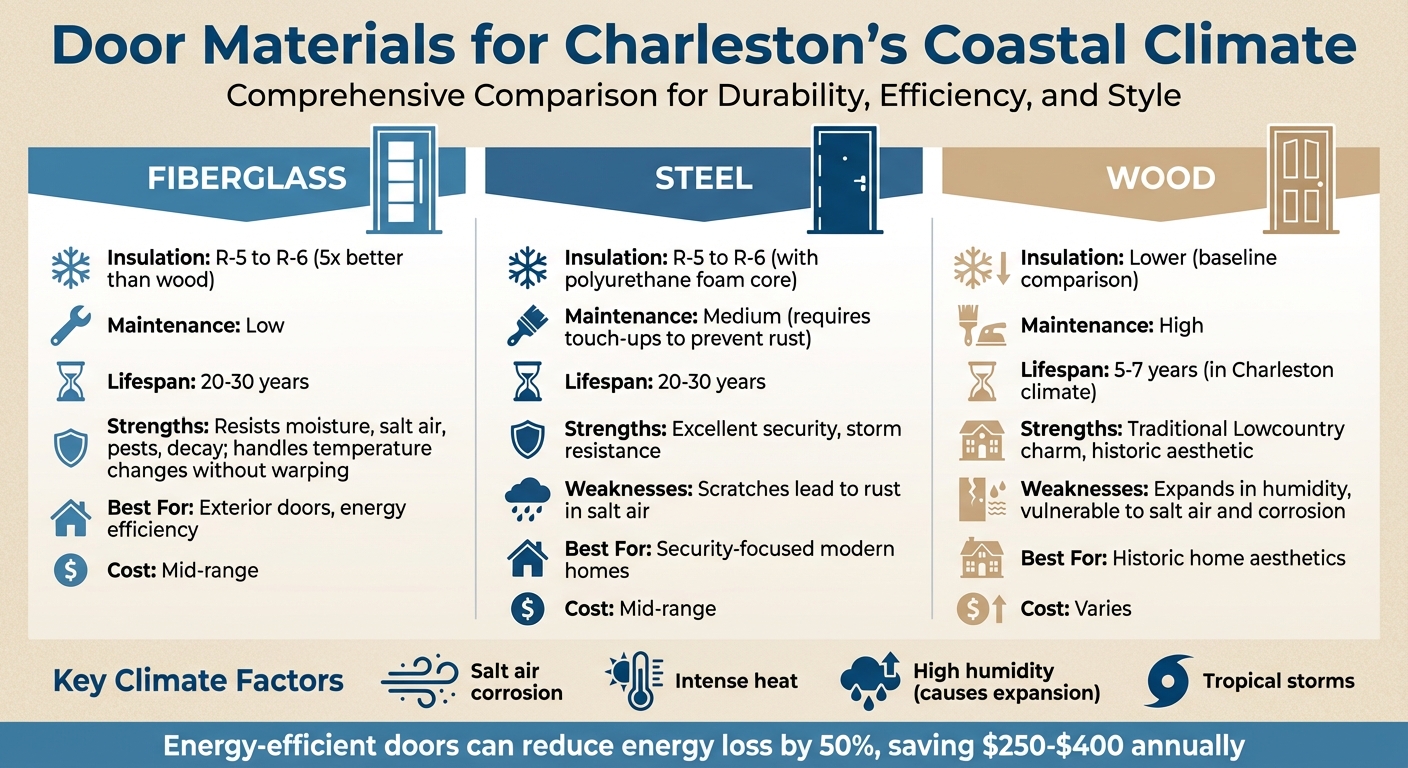
Charleston Door Materials Comparison: Fiberglass vs Steel vs Wood Performance
What to Consider When Choosing a Door
Start by getting accurate measurements of your door frame, including the slab and jamb. It’s crucial to allow enough clearance to avoid issues like sticking, especially since wood tends to expand in Charleston’s humid climate. Beyond the fit, think about how the door will function in your daily life. Do you need a window to let in natural light, or is a solid-core door better for privacy and insulation?
Look for doors with a low Solar Heat Gain Coefficient (SHGC) and weatherproof seals. These features can help block solar heat and reduce energy loss by as much as 50%, potentially saving you $250–$400 a year on energy bills. Insulated cores are another great option, as they cut down on thermal transfer, which is especially important during Charleston’s hot, muggy summers.
Don’t overlook security. Opt for advanced multi-point locks, reinforced frames, and strike plates installed with extra-long screws for stronger protection against break-ins. If you live near the coast, choose corrosion-resistant hardware to guard against the salt air, which can quickly wear down locks and hinges.
With these factors in mind, explore door styles that complement Charleston homes.
Common Door Types for Charleston Homes
Front entry doors are the first impression of your home. Wood doors bring timeless Lowcountry charm that aligns beautifully with Charleston’s historic architecture. For a similar look but less upkeep, fiberglass is a great alternative. On the other hand, steel doors are ideal for modern homes where security is the top concern. Each material has its own advantages for standing up to the coastal environment.
French doors remain a popular option for both interior transitions and garden access. Their glass panels allow natural light to brighten your space while offering an elegant, traditional style that fits Charleston’s architectural heritage. For interiors, primed panel doors with recessed or raised designs add depth and character to bedrooms and hallways.
Patio and garden doors are perfect for connecting indoor spaces to outdoor areas. Sliding glass doors with vinyl frames are energy-efficient for contemporary homes, while hinged garden doors have a more classic look. If space is tight, barn doors are a trendy choice that adds rustic charm and works well where swinging doors aren’t practical. Pocket doors and bi-fold doors are also smart solutions for smaller historic homes, especially for closets and utility rooms.
Materials That Withstand Charleston’s Climate
Choosing materials that can handle Charleston’s coastal conditions is essential. Fiberglass stands out as one of the best options. It resists moisture, salt air, pests, and decay, all while being low-maintenance. Insulated fiberglass doors typically offer R-values between R-5 and R-6, delivering over five times the insulating power of a solid wood door of the same size. Plus, fiberglass can handle extreme temperature changes without warping or cracking, making it a top pick for exterior doors.
"Fiberglass is a good option when you want something that’s going to hold up well for a long time and keep thermal energy from escaping your house." – Mr. Handyman of Charleston and Summerville
Steel doors are another solid choice, offering excellent security against tropical storms. However, they require maintenance – scratches should be touched up quickly to prevent rust from the salt air.
Wood composite materials are engineered to withstand the intense humidity of the Lowcountry. They offer a balance between the natural beauty of wood and the durability of synthetics. For patio sliders, vinyl is a smart choice, providing excellent insulation against heat while requiring minimal upkeep. Clad finishes, which combine the aesthetic of wood with a protective outer layer, are also available, though they tend to be more expensive than fiberglass or steel options.
sbb-itb-cdbcc3e
What to Expect During Door Installation
Preparing for Installation
Start by measuring your door frame. The rough opening should be about 2 to 2.5 inches wider than the pre-hung door unit. Make sure the door jamb matches the thickness of your wall, including any drywall. Decide on the door’s swing direction – whether it opens inward or outward, to the left or right – so it doesn’t block hallways or bump into furniture.
If a standard swing door won’t work in your space, you might want to look into alternatives like pocket doors, barn doors, or bifold styles. Before the installation, clear the entry area to make room for the work. If you live in Charleston’s Historic District, don’t forget to get approval from the Board of Architectural Review before making any changes to exterior doors.
How Professionals Install Your Door
The process begins with removing the old door slab, hinges, strike plates, and jambs. Next, the new pre-hung door unit is placed into the rough opening. Professionals use wooden shims to level and position the jambs before securing the frame to the wall studs. This attention to detail ensures the door functions properly for years to come.
"Door installation demands precise measurements and adaptive problem-solving." – Mr. Handyman of Charleston and Summerville
Given Charleston’s coastal climate, installers often use double weather-stripping and specialized sealants to combat high humidity and salt air. They also secure locks and strike plates with extra-long screws that anchor into wall studs. Once the hardware is in place, they install the trim and check that the door swings smoothly without any obstructions. Most installations are completed within one to two days. After everything is securely fastened, the installer wraps up their work, leaving it ready for your inspection.
After Installation: Inspection and Maintenance
After installation, take time to inspect the work alongside your installer. Check that the door opens and closes smoothly without sticking or jerking. Run your hand along the edges to see if you can feel any air drafts – gaps in the seal could increase your energy bills by overworking your HVAC system.
Ensure all hardware latches easily and without force. Review the warranty details, as some local installers offer lifetime labor warranties, while others may provide a standard one-year warranty. Regular maintenance is key, especially in Charleston’s coastal environment. For steel doors, look out for scratches or paint chips and address them quickly to prevent rust from forming due to the salty air. With proper care, your new door can last anywhere from 20 to 30 years in this climate.
Why Energy-Efficient Doors Matter
Charleston’s hot summers and sticky humidity make energy-efficient doors a smart choice for keeping homes comfortable while cutting down on energy bills. Believe it or not, outdated doors and windows can account for up to 32% of your home’s energy loss. By upgrading to energy-efficient doors, you could slash that loss by as much as 50%.
"Your home’s exterior doors can contribute significantly to air leakage, and can also waste energy through conduction, especially if it’s old, uninsulated, improperly installed, and/or improperly air sealed." – U.S. Department of Energy
Well-designed doors with insulated cores and proper weatherstripping are like shields against Charleston’s intense heat. They keep the outside air where it belongs – outside – while easing the load on your air conditioner, all without sacrificing indoor comfort. The secret lies in the specific features these doors offer, which we’ll explore next.
Features of Energy-Efficient Doors
For Charleston’s climate, steel or fiberglass doors with polyurethane foam insulation cores are a solid choice. R-values, which measure thermal resistance, are crucial here. Doors with R-values between R-5 and R-6 are especially effective at cutting energy costs during those long, hot summers.
If your door includes glass or you’re considering patio sliders, pay attention to the details. Look for glass that’s at least 1 inch thick, features low-emissivity (Low-E) coatings, and has argon gas fills between panes. In Charleston’s heat-heavy environment, the Solar Heat Gain Coefficient (SHGC) is another key factor – a lower SHGC means less solar heat gets inside. These ratings are easy to spot on the National Fenestration Rating Council (NFRC) label, which also lists the U-factor, a measure of the door’s overall resistance to heat flow.
Weatherstripping is another unsung hero in energy efficiency. It creates a tight seal that keeps Charleston’s humid, salty air at bay. Given the area’s coastal conditions and potential for hurricanes, it’s wise to choose doors with corrosion-resistant hardware and impact-resistant glass. Swinging patio doors are generally better at sealing out air compared to sliding ones, which often allow leaks around their tracks.
Savings and Environmental Impact
Energy-efficient doors don’t just perform well – they save you money and are kinder to the planet. Most Charleston homeowners report energy cost reductions of 15% to 25% after installing these doors. Over time, these savings can offset the initial cost, making the investment worthwhile. On top of that, using less electricity helps reduce your overall environmental footprint.
A well-sealed, insulated door also plays a role in maintaining your home’s durability. By blocking drafts and controlling moisture, it prevents wood rot and keeps indoor air quality high, even in Charleston’s humid conditions. With proper care, these doors can last 20 to 30 years, continuing to perform well in the challenging coastal climate.
When shopping for energy-efficient doors, always look for the ENERGY STAR label – it guarantees the door meets energy-saving standards for your region. And don’t forget to check the weatherstripping annually to keep your door performing at its best.
Finding Door Suppliers and Installers in Charleston
Benefits of Working with Local Suppliers
Charleston’s coastal environment presents unique challenges, from corrosive salt air to intense weather conditions. Local suppliers are well-equipped to tackle these issues, offering solutions specifically designed for long-term durability in this region. With years of experience addressing the area’s specific needs, they understand which materials and features stand up best to the elements, ensuring your doors last as long as possible.
But it’s not just about the products. Local suppliers often bring decades of expertise in construction and project management, giving them an edge when it comes to navigating regional building codes and tailoring solutions to Charleston’s unique conditions. Many even offer personalized service that goes beyond the sale, such as on-site evaluations. These visits allow experts to assess your home’s exposure to coastal elements and recommend the best options, like weatherproof seals, impact-resistant glass, or corrosion-resistant hardware.
As Mr. Handyman of Charleston and Summerville puts it:
"Door installation may sound simple, but it often requires a lot of tricky measurements and the ability to think on your feet to come up with solutions for unexpected problems."
Another big advantage of working with local professionals is the warranties they provide. Most stand behind their work, addressing any alignment or operational issues at no extra cost. This level of accountability can be harder to find with suppliers who lack a local presence. Among Charleston’s top providers, one company has distinguished itself for its specialized service and expertise.
Icon Window & Door: Charleston’s Door Specialists
Icon Window & Door, a family-owned business established in 2020, has quickly become a trusted name in Charleston and the surrounding areas. With a perfect 5-star rating from local clients, they’ve earned praise for their ability to source custom-sized doors that are often hard to find elsewhere. One satisfied customer, Abby R., shared:
"Icon Window and Door is the best quality in the Lowcountry. I always recommend this company to friends and family".
What makes Icon Window & Door stand out is their dedication to providing a seamless experience from consultation to installation. They partner with respected manufacturers like Sun Windows and Doors, Masonite, TruStile, and PGT Sliders, offering a variety of materials such as fiberglass, steel, wood, and clad finishes. Every installation includes a one-year workmanship warranty on top of manufacturer warranties, giving customers added peace of mind.
Located near the South Carolina Ports Authority Wando Terminal, their warehouse ensures efficient access to both domestic and international product options. This combination of local expertise and high-quality service makes Icon Window & Door a standout choice for door replacements in Charleston.
Conclusion
Choosing the right door for your home goes beyond aesthetics – it’s about boosting energy efficiency, enhancing security, and ensuring durability. In Charleston’s unique coastal climate, with its high humidity, salt air, and intense heat, doors must be designed to handle these harsh conditions while offering reliable performance over time.
When replacing a door in Charleston, it’s important to focus on materials and features suited to the Lowcountry’s demands. Fiberglass and steel doors with insulated cores are excellent options, as they resist heat, humidity, and salt air while cutting energy costs by 15%–25%. This could save you between $250 and $400 annually. Features like Low-E glass, weatherproof seals, and corrosion-resistant hardware provide year-round protection and efficiency.
Proper installation can’t be overlooked. Even the best door won’t deliver its full benefits if it’s not installed correctly. Professional installers ensure a precise fit, preventing air leaks, moisture intrusion, and other issues that can raise energy bills and reduce the door’s lifespan.
Security is another key factor. Doors equipped with multi-point locks, reinforced strike plates, and heavy-duty hinges offer protection against both intruders and severe weather. However, these features are only as effective as their installation, so professional expertise is crucial.
Lastly, work with suppliers who back their products with workmanship warranties, partner with trusted manufacturers, and offer personalized guidance. By investing in durable materials, energy-saving features, and skilled installation, you’ll enjoy a secure, efficient, and comfortable home for years to come.
FAQs
What door materials work best for Charleston’s coastal climate?
For Charleston’s hot, humid, and salty coastal climate, fiberglass, steel, and vinyl (including clad) doors stand out as smart choices. These materials handle moisture, warping, and corrosion exceptionally well, making them a solid option for lasting durability in such challenging conditions.
Fiberglass doors are a favorite due to their adaptability and minimal upkeep. Steel doors, on the other hand, provide unmatched strength and added security. Vinyl-clad doors bring together weather resistance and an attractive look, making them a practical yet stylish option. Picking the right material ensures your door holds up against the elements while staying functional and looking great for years to come.
How do energy-efficient doors help lower my utility bills?
Energy-efficient doors come equipped with advanced insulation and airtight seals that help maintain a consistent indoor temperature throughout the year. By cutting down on drafts and limiting heat transfer, these doors reduce the strain on your HVAC system, which can lead to noticeable savings on heating and cooling costs.
Switching to energy-efficient doors can lower your utility bills by an estimated 10–12%, saving you roughly $200–$400 each year. Over time, these savings not only help recover the upfront cost but also make your home more comfortable and environmentally friendly.
What should I look for when hiring a professional to install a new door?
When hiring a professional to install your door, it’s essential to start with the basics: make sure they are licensed, insured, and bonded. This not only safeguards you against accidents but also ensures the work complies with local building codes. In Charleston, where the climate brings heat, humidity, and the occasional storm, it’s crucial to choose someone familiar with these conditions to ensure your door stays secure and functional for years to come.
A contractor’s reputation speaks volumes, so take the time to check reviews and ask for references. Look for someone with proven expertise in handling precise measurements, alignment, and hardware installation. A knowledgeable installer should also suggest energy-efficient solutions, such as insulated doors and proper weather-stripping, which can help cut down on energy bills.
Before moving forward, make sure the installer provides a detailed written estimate. This should outline labor, materials, and any extra services, like removing your old door. Don’t forget to ask about warranties for both the door and the workmanship. Lastly, confirm that their process includes sealing gaps and thoroughly cleaning up once the job is done. By following these steps, you can ensure a smooth installation and a durable, well-fitted door.