Energy-efficient door hardware plays a key role in reducing energy loss and improving home comfort. While Energy Star certification applies to entire door systems (not individual components), hardware like locks, weatherstripping, and thresholds ensure tight seals that prevent air leakage. Here’s what you need to know:
- Locks: Multi-point locking systems secure the door at multiple points, reducing air gaps and improving insulation.
- Weatherstripping & Thresholds: Magnetic strips, door sweeps, and composite thresholds block drafts and minimize heat transfer.
- Material Matters: Hardware made from low-conductivity materials (like polyamide) prevents heat from escaping compared to metal components.
- Performance Metrics: Look for doors with low U-factors (better insulation) and low SHGC values (reduces heat from sunlight, ideal for warm climates).
Proper installation and maintenance are essential to maximize these benefits. Federal tax credits of up to $250 per door can help offset costs for Energy Star-certified upgrades. Investing in the right door hardware improves energy efficiency, lowers utility bills, and enhances indoor comfort.
How Door Hardware Affects Energy Star Performance
The hardware on a door plays a key role in determining its energy efficiency. Poorly fitted components or using materials that conduct heat can weaken seals and reduce overall performance. Let’s break down how specific hardware features influence energy efficiency.
Multi-Point Locking Systems and Compression Locks
Unlike standard deadbolts that secure only one point, multi-point locking systems engage three or more points along the door’s height. This design ensures a tighter compression of the weatherstripping, minimizing air leakage. Reduced air leakage directly improves the Energy Rating (ER), as it’s a factor subtracted in the ER formula. Additionally, these systems help prevent bowing or warping of the door, which could otherwise compromise the seal over time.
Weatherstripping, Sweeps, and Thresholds
Magnetic weatherstripping, often used on steel-clad doors, functions much like a refrigerator door seal, creating a tight closure when aligned correctly. Door sweeps address the gap at the bottom of the door, while thresholds complete the system to block air from passing through. For added efficiency, expanding foam or caulking can seal the gap between the doorframe and the rough opening, stopping air from bypassing these barriers. The EPA notes that unnoticed air leaks in a typical home can add up to the equivalent of leaving a window open.
Low-Conductivity Materials in Hardware
Metal hardware can act as a thermal bridge, allowing heat to escape in winter or enter during summer. For example, aluminum thresholds or steel hinges provide direct pathways for heat transfer. By contrast, composite thresholds and polyamide thermal breaks disrupt these paths. Polyamide, with a thermal conductivity about 1,000 times lower than aluminum, significantly reduces heat transfer. Thermally broken systems can cut heat transfer by up to 75%, leading to energy savings of 15% to 40%, depending on the climate zone.
"Professional testing demonstrates that thermal break door systems can reduce heat transfer by up to 75% compared to non-thermally broken alternatives, resulting in measurable energy savings and enhanced occupant comfort." – Gladiator Window & Doors
Thermal breaks also help maintain warmer interior door and frame surfaces, reducing condensation and protecting nearby materials from moisture-related damage over time.
sbb-itb-cdbcc3e
How to Choose Energy-Efficient Door Hardware
Selecting the right hardware goes beyond aesthetics – it plays a key role in how effectively your door seals and insulates. A few well-informed choices can make a noticeable difference in your home’s energy efficiency.
To get the best results, it’s important to match the hardware to your door’s material and type while also considering performance metrics.
Matching Hardware to Door Material and Type
Different door materials require specific hardware to ensure optimal sealing and insulation. For example:
- Steel doors: Magnetic strip weatherstripping is ideal here. It creates a strong, refrigerator-style seal without relying on compression.
- Fiberglass doors: These often come pre-hung with built-in weatherstripping that holds up well over time.
- Wood doors: While visually appealing, wood doors are more prone to issues like warping. Proper frame alignment during hardware installation is crucial to maintain a tight seal.
For patio doors, swinging doors are a better choice than sliding ones. Sliding doors tend to allow more air leakage, especially as their seals wear down over time. A fixed panel combined with one operating panel is also more efficient than a setup with two operating panels.
| Door Type | Key Hardware Consideration |
|---|---|
| Steel (insulated) | Magnetic strip weatherstripping; R-5 to R-6 insulation value |
| Fiberglass | Integrated weatherstripping; durable over time |
| Solid wood | Requires precise frame alignment; sensitive to warping |
| Metal-framed glass | Needs a thermal break to reduce heat conduction |
Reviewing Performance Metrics
When evaluating hardware and door assemblies, the NFRC (National Fenestration Rating Council) label is your go-to resource. It provides key performance ratings, including:
- U-factor: Indicates how quickly heat passes through the door assembly. A lower U-factor means better insulation.
- SHGC (Solar Heat Gain Coefficient): For warmer climates, like South Carolina, a lower SHGC is ideal to block solar heat during hot summers.
- Air leakage: The lower this value, the fewer drafts you’ll experience.
Given South Carolina’s cooling-dominated climate, choosing a product with a low SHGC is especially important. Additionally, for metal-framed doors, ensure the hardware includes a thermal break to interrupt heat conduction.
If the technical details feel overwhelming, seeking advice from local professionals can save time and ensure accuracy.
Getting Help from Local Experts
Navigating specifications can be tricky, especially with the updated Energy Star Version 7.0 requirements (effective October 23, 2023), which introduce stricter U-factor and SHGC thresholds based on climate zones and glazing levels. This is where local expertise becomes invaluable.
For example, Icon Window & Door assists South Carolina homeowners in selecting hardware that aligns with the Southern climate zone’s specific Energy Star standards. Their team ensures the hardware is compatible with your door type, meets local energy requirements, and is installed correctly to preserve manufacturer warranties. Proper installation matters – a poorly installed door, even with excellent ratings, won’t perform as expected.
Installation and Maintenance for Lasting Efficiency
To maximize energy savings, proper installation and regular maintenance of door hardware are essential. Even the most efficient Energy Star-rated hardware will underperform without these critical steps. Here’s how to ensure your doors stay energy-efficient for the long haul.
Installation Best Practices
Getting the frame perfectly square is the foundation of a successful installation. The U.S. Department of Energy emphasizes:
"The doorframe must be as square as possible, so that the door seals tightly to the jamb and swings properly."
Before adding interior trim, seal any gaps between the doorframe and the rough opening with expanding foam caulking. Unsealed gaps can let air slip past the weatherstripping, reducing efficiency. Be cautious with foam application on wood frames, as excess foam can warp the frame. For metal-framed glass doors, double-check for a thermal break during installation – this feature is crucial for maintaining energy efficiency. If you’re working with pre-hung Energy Star doors, follow the manufacturer’s guidelines closely, as they often include factory-installed weatherstripping.
Routine Maintenance Tips
Once installed, ongoing maintenance is the key to keeping everything working efficiently. Door hardware, in particular, needs more frequent attention than the door itself. Regular inspections of weatherstripping, thresholds, and caulking can help maintain a tight seal and reduce energy loss.
The U.S. Department of Energy advises inspecting weatherstripping on all exterior doors at least once a year. Here’s a breakdown of essential maintenance tasks and how often to perform them:
| Maintenance Task | Frequency | Purpose |
|---|---|---|
| Inspect weatherstripping | Annually | Look for cracks, stiffness, or compression failure |
| Adjust threshold | As needed | Close gaps caused by settling or thermal expansion |
| Inspect exterior caulking | Seasonally | Prevent air and moisture infiltration around the frame |
| Lubricate hinges and locks | Annually | Ensure smooth operation and proper latching for a tight seal |
| Check frame squareness | Every 2–3 years | Ensure the door slab aligns evenly with all seals |
For steel doors with magnetic weatherstripping, alignment is everything. If the door becomes bent or misaligned, the magnetic strip may lose contact, weakening the seal. Sliding glass doors require even more vigilance – replace worn weatherstripping as soon as you notice wear. Because sliding doors inherently allow some air leakage, even minor seal issues can lead to significant energy loss over time.
Benefits and Cost Considerations
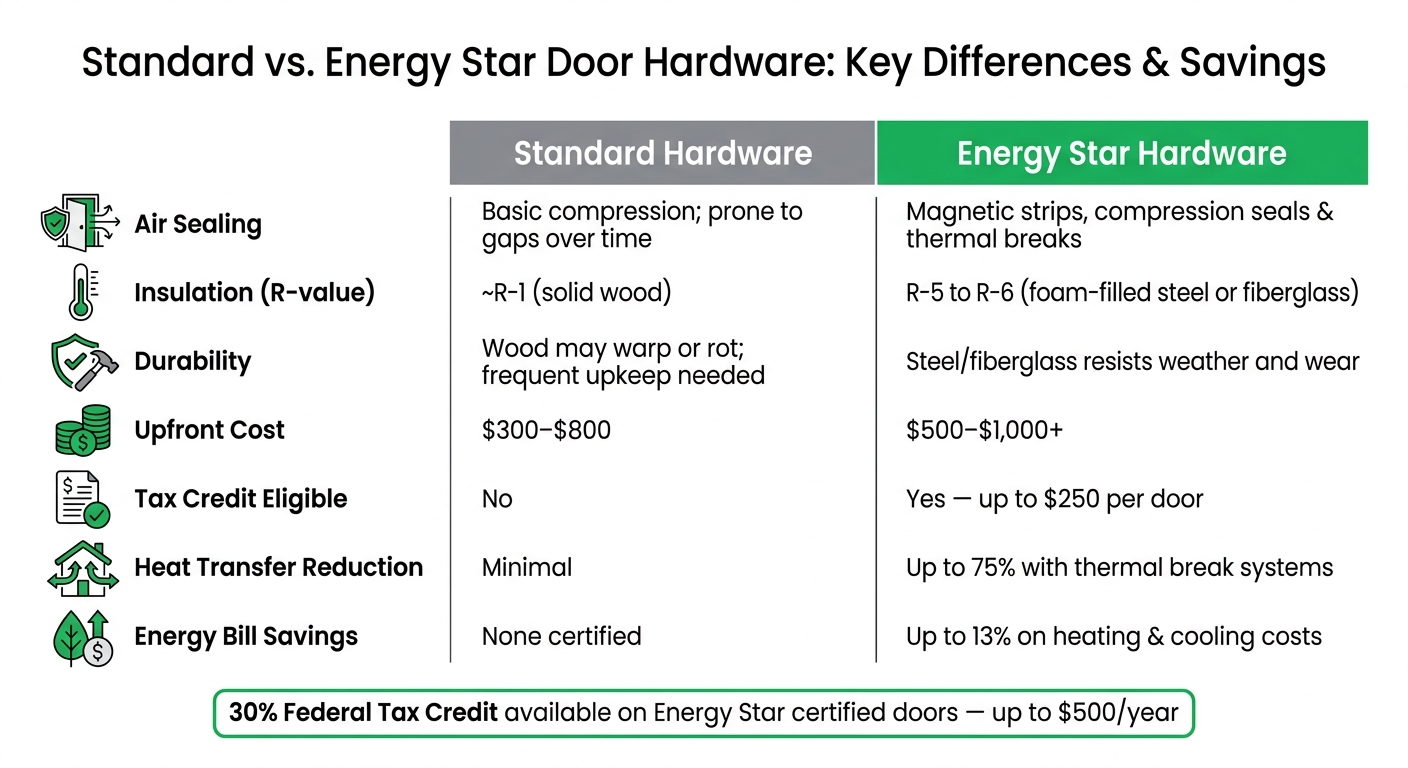
Standard vs. Energy Star Door Hardware: Key Differences & Savings
Practical Benefits for Homeowners
Energy-efficient door hardware offers more than just a modern look – it can significantly lower utility bills. According to Energy Star:
"Installing ENERGY STAR certified windows, doors, and skylights can shrink energy bills by an average of up to 13% on heating and cooling costs nationwide, compared to non-certified products."
A well-sealed door keeps drafts out, helping maintain a consistent indoor temperature without constant thermostat adjustments. Beyond comfort, these doors often include UV protection. Coated energy-efficient door glass can cut down fading on furniture, flooring, and curtains by as much as 75%. Moreover, the same insulation that prevents heat transfer also reduces outside noise, creating a quieter living space. However, these advantages often come with higher upfront costs.
Cost and Tradeoffs
The initial expense for energy-efficient doors can vary widely. Standard exterior doors typically cost between $300 and $1,000, while energy-efficient sliding glass doors range from $1,200 to $5,500. To offset these costs, federal tax credits are available. Homeowners can claim 30% of the cost for Energy Star certified exterior doors, up to $250 per door, with a maximum of $500 annually. For those replacing multiple doors, spreading the project over two tax years helps maximize credits within the $1,200 annual limit for home envelope improvements.
The differences between standard and Energy Star-certified hardware include:
| Feature | Standard Hardware | Energy Star Hardware |
|---|---|---|
| Air Sealing | Basic compression; prone to gaps over time | Magnetic strips, compression seals, and thermal breaks |
| Insulation (R-value) | ~R-1 (solid wood) | R-5 to R-6 (foam-filled steel or fiberglass) |
| Durability | Wood may warp or rot; requires frequent upkeep | Steel/fiberglass resists weather and wear |
| Upfront Cost | $300–$800 | $500–$1,000+ |
| Tax Credit Eligible | No | Yes – up to $250 per door |
Keep in mind, sliding glass doors naturally allow more air leakage than swinging doors due to their sealing mechanisms. For spaces where sliding doors are preferred, opting for magnetic weatherstripping and low-e glass can improve performance. Ultimately, balancing the higher initial investment with the long-term energy savings is crucial when choosing the right door for your home.
Conclusion
Switching to Energy Star certified door hardware is a smart move for any homeowner. When installed correctly, a combination of tight seals, quality weatherstripping, and materials with low thermal conductivity can cut annual energy bills by about 12%, while also improving indoor comfort.
The key to getting the most out of your door hardware lies in proper installation and choosing the right materials. Be sure to look for products with Energy Star and NFRC labels to ensure they meet the standards for your climate. For top-notch insulation, consider insulated steel or fiberglass doors with a polyurethane foam core, which outperform solid wood options.
"Even the best windows, doors, and skylights can be drafty if they are poorly installed." – ENERGY STAR
This quote highlights the importance of professional installation. To avoid costly mistakes, consult an expert to ensure everything is done right the first time. If you’re based in South Carolina, Icon Window & Door offers personalized consultations to help you find the perfect doors and hardware for your home. Their team can also guide you through federal tax credit options, making the upgrade even more worthwhile.
FAQs
Does Energy Star certify door hardware or the whole door?
ENERGY STAR certification applies to door hardware, not entire doors. However, when doors are equipped with certified hardware, they can qualify for ENERGY STAR certification based on the door’s overall energy efficiency.
Which door hardware upgrades reduce drafts the most?
Weatherproof entry doors, combined with quality weatherstripping and proper sealing, are excellent at cutting down drafts. These improvements help prevent air from sneaking in through gaps and around the door frame. As a result, they play a big role in boosting energy efficiency by maintaining a more stable indoor temperature.
How do I know if a door meets Energy Star standards for my climate zone?
To determine if a door aligns with Energy Star standards for your specific climate zone, start by using the ENERGY STAR Climate Zone Finder. Once you’ve identified your zone, verify that the door’s Certified Product Directory (CPD) number appears in the NFRC Certified Product Directory. Look for a check mark next to your zone, which confirms the door is certified for energy efficiency in your area.